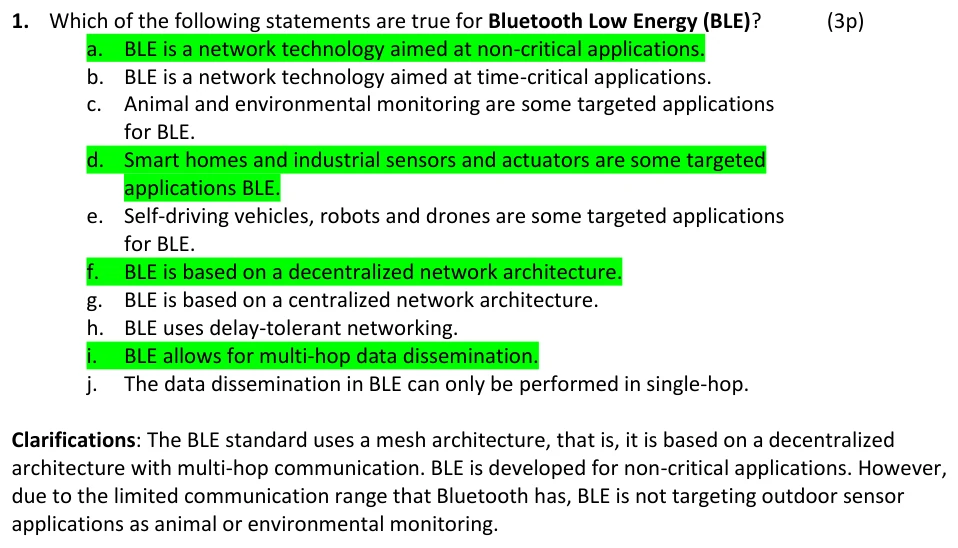
Officiell lösning saknas. Följande är ett LLM-förslag som utgår från kursmaterialet. Kontrollera alltid mot föreläsningar och artiklar.
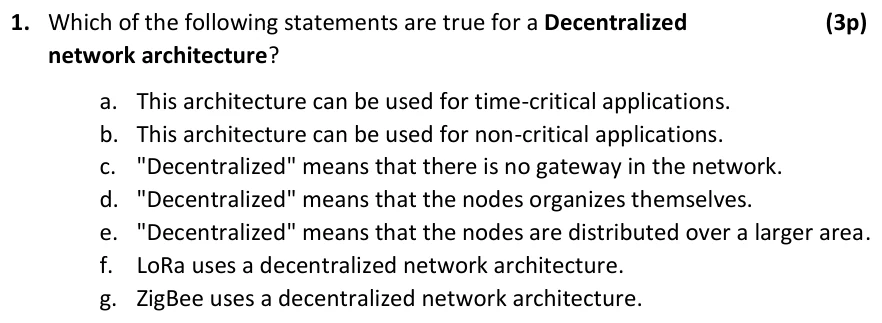
LLM-förslag: rätt är att decentraliserade nät kan användas för både tidskritiska och icke-tidskritiska applikationer, att noderna organiserar sig själva och att ZigBee använder en decentraliserad mesh-arkitektur. Fel: att det inte finns gateway, att decentralisering betyder geografisk spridning, och att LoRa är decentraliserat (LoRaWAN är centraliserat).
Se Network architectures, avsnittet om centraliserade/decentraliserade arkitekturer.
Officiell lösning saknas. Följande är ett LLM-förslag som utgår från kursmaterialet. Kontrollera alltid mot föreläsningar och artiklar.
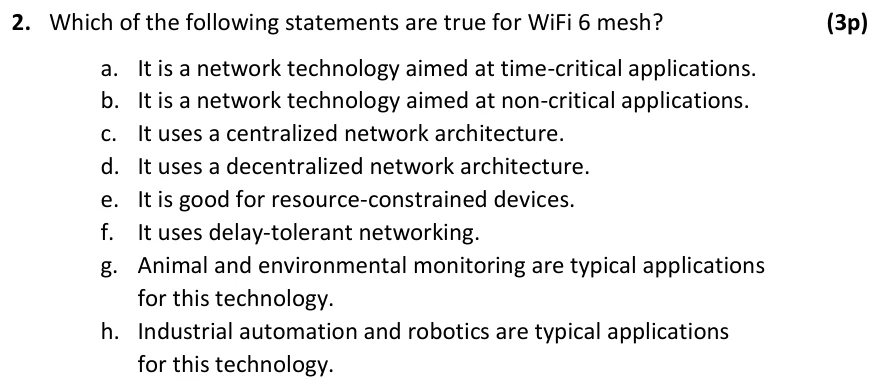
LLM-förslag: WiFi 6 mesh är främst avsett för icke-tidskritiska applikationer och använder en decentraliserad mesh-arkitektur. Det är inte ett DTN och är inte specifikt för resursbegränsade enheter. Industriell automation kan vara ett möjligt användningsområde, men är inte det typiska huvudsyftet i kursen.
Officiell lösning saknas. Följande är ett LLM-förslag som utgår från kursmaterialet. Kontrollera alltid mot föreläsningar och artiklar.
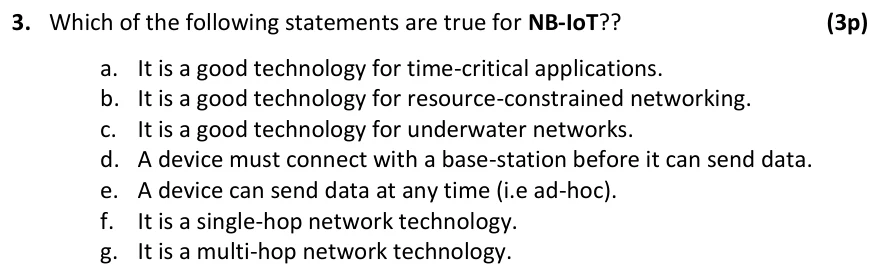
LLM-förslag: NB-IoT är bra för resursbegränsad kommunikation, kräver en basstation och är single-hop. Det är inte tidskritiskt, inte avsett för undervatten och inte ad-hoc/multi-hop.
Officiell lösning saknas. Följande är ett LLM-förslag som utgår från kursmaterialet. Kontrollera alltid mot föreläsningar och artiklar.
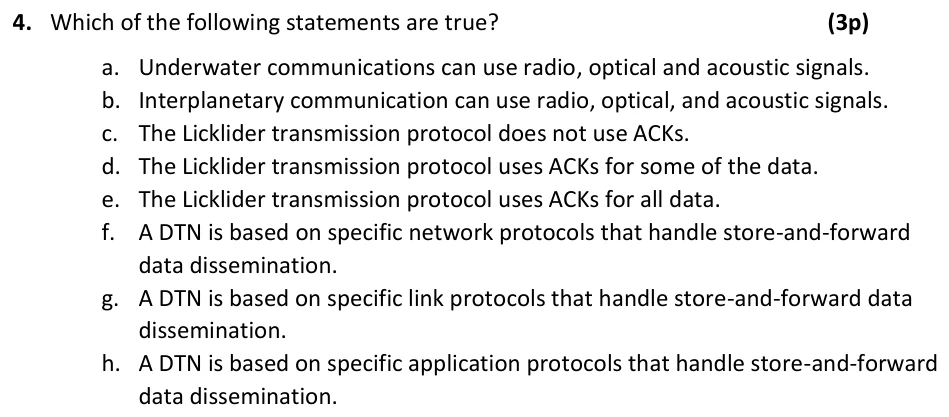
LLM-förslag: undervattenskommunikation kan använda radio, optik och akustik. LTP använder ACK för delar av data (selektiv ARQ), inte för allt. DTN är ett overlay-protokoll på applikationsnivå, inte ett länkprotokoll.
Officiell lösning saknas. Följande är ett LLM-förslag som utgår från kursmaterialet. Kontrollera alltid mot föreläsningar och artiklar.
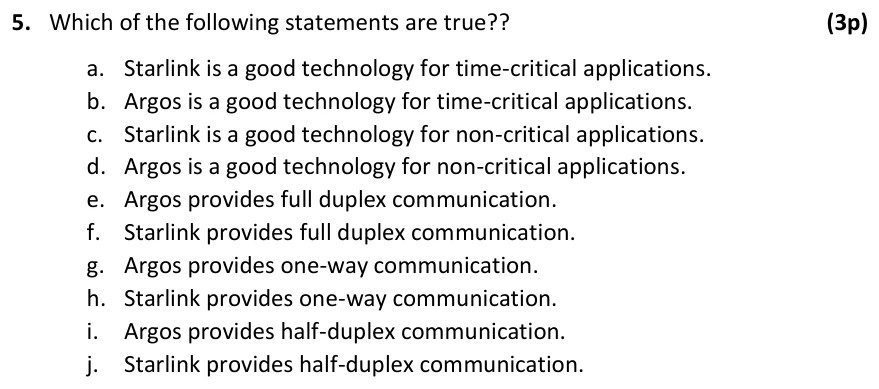
LLM-förslag: både Starlink och Argos är i första hand för icke-tidskritiska applikationer. Starlink är tvåvägs bredband; Argos är i huvudsak enkelriktad telemetri. Varken Argos eller Starlink ska beskrivas som full duplex för alla tjänster.
Which of the following statements are true for LoRa? (3p)
Välj ett eller flera alternativ.
It is a network technology aimed at non-critical applications.
Animal and environmental monitoring are typical applications of this technology.
It uses delay-tolerant networking.
It uses a decentralized network architecture.
Industrial automation and robotics are typical applications of this technology.
It is a network technology aimed at time-critical applications.
This technology can be used for self-driving vehicles and drones.
It uses a centralized network architecture.
It is good for resource-constrained devices.
Poäng
3 p
Visa LLM-lösning
Officiell lösning saknas. Följande är ett LLM-förslag som utgår från kursmaterialet. Kontrollera alltid mot föreläsningar och artiklar.
LLM-förslag: rätt är att LoRa är för icke-tidskritiska applikationer, att djur- och miljöövervakning är typiska användningar, att det använder en centraliserad arkitektur och att det passar resursbegränsade enheter. LoRa använder inte DTN som princip och är inte avsett för självkörande fordon eller tidskritisk styrning.
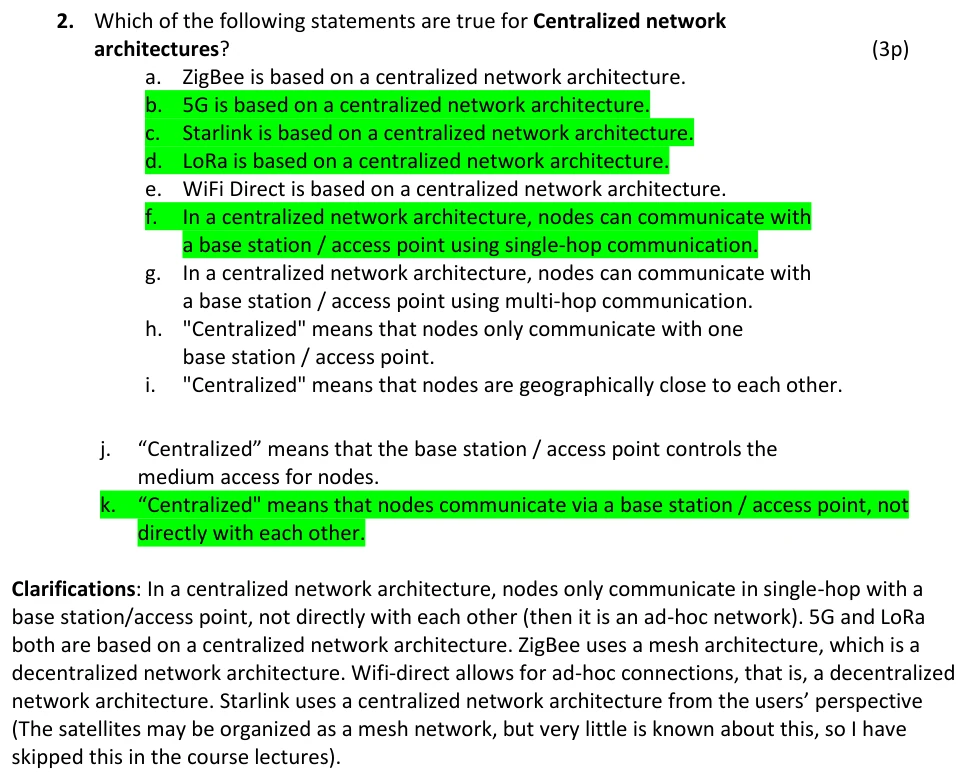
Which of the following statements are true for a Centralized network architecture? (3p)
Välj ett eller flera alternativ.
"Centralized" means that a gateway organizes the network.
This architecture can be used for time-critical applications.
ZigBee uses a centralized network architecture.
This architecture can be used for non-critical applications.
"Centralized" means that nodes use single-hop communication with the gateway.
"Centralized" means that the nodes are geographically close to each other.
5G uses a centralized network architecture.
"Centralized" means that nodes only communicate with one gateway.
"Centralized" means that the nodes organize themselves.
Poäng
3 p
Visa LLM-lösning
Officiell lösning saknas. Följande är ett LLM-förslag som utgår från kursmaterialet. Kontrollera alltid mot föreläsningar och artiklar.
LLM-förslag: centraliserad arkitektur kan användas för både tidskritiska och icke-tidskritiska applikationer. Noder kommunicerar single-hop med basstation/accesspunkt, och 5G är centraliserat. Det betyder inte att noderna måste ligga geografiskt nära eller organisera sig själva; ZigBee mesh är decentraliserat.
Radio communication underwater works well when high frequency bands are used.
Beamforming can be used to increase the radio range.
Higher frequency bands mean a longer radio range compared with lower frequency bands.
Beamforming can be used to increase the data communication capacity.
Radio communication in space works well when high frequency bands are used.
Higher frequency bands mean a shorter radio range compared with lower frequency bands.
Poäng
3 p
Visa LLM-lösning
Officiell lösning saknas. Följande är ett LLM-förslag som utgår från kursmaterialet. Kontrollera alltid mot föreläsningar och artiklar.
LLM-förslag: beamforming kan öka både räckvidd och kapacitet. Högre frekvenser har generellt kortare räckvidd på jorden men kan bära mer data. Radio i rymden kan använda höga frekvenser. Radio under vatten fungerar inte bra på höga frekvenser.
Which of the following statements are true for resource-constrained networking? (3p)
Välj ett eller flera alternativ.
LoRa is suitable for resource-constrained networking.
Gossiping is a MAC protocol aimed for resource-constrained networking.
Multi-hop communication can be used.
The nodes have limited power supply.
Single-hop communication can be used.
Resource-constrained networking and delay-tolerant networking use the same principles.
IEEE 802.11ax is suitable for resource-constrained networking.
The gateways have limited power supply.
Poäng
3 p
Visa LLM-lösning
Officiell lösning saknas. Följande är ett LLM-förslag som utgår från kursmaterialet. Kontrollera alltid mot föreläsningar och artiklar.
LLM-förslag: LoRa är lämpligt, multi-hop och single-hop kan användas, och noderna har begränsad energi. Gossiping är en forwarding/routing-teknik, inte ett MAC-protokoll. DTN och resursbegränsad nätning är olika begrepp; 802.11ax är inte primärt för resursbegränsade enheter, och gatewayerna är normalt inte energibegränsade.
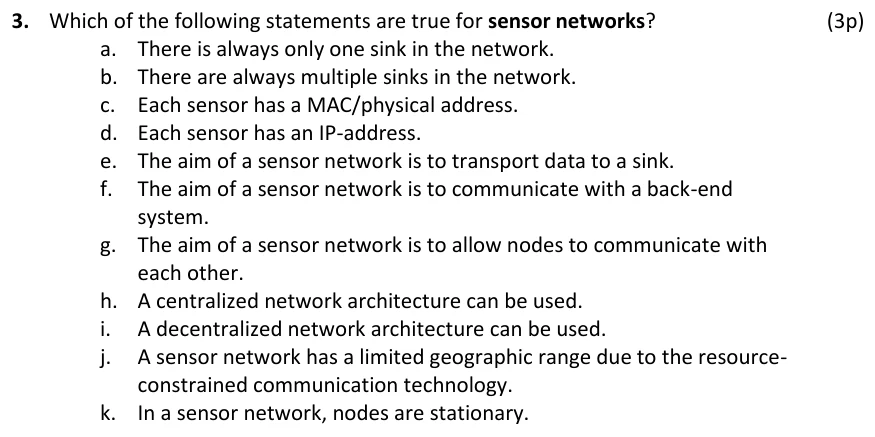
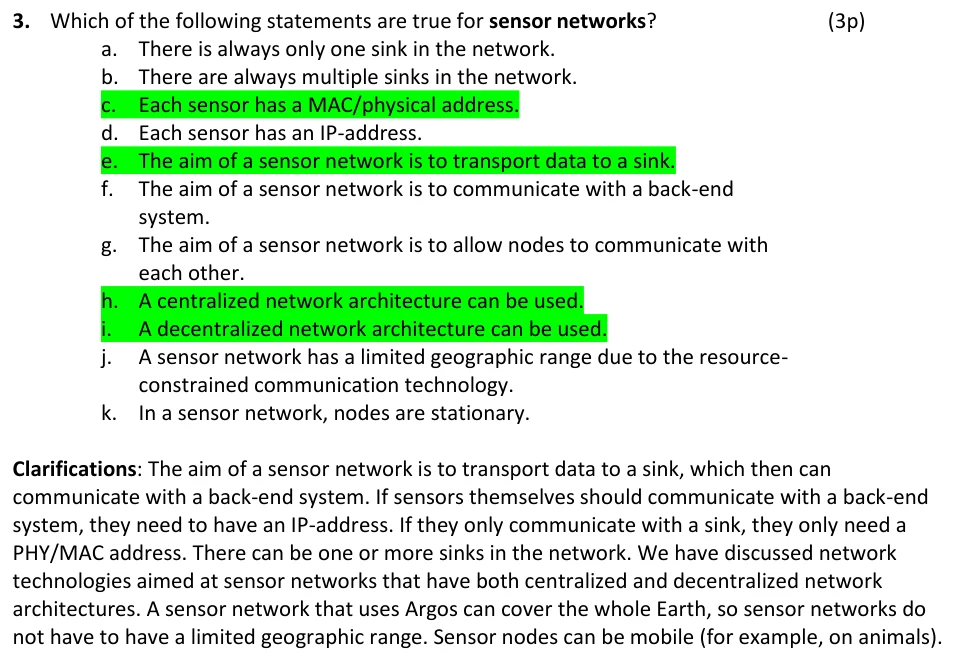
Which of the following statements are true for sensor networks? (3p)
Välj ett eller flera alternativ.
A decentralized network architecture can be used.
The aim of a sensor network is to communicate with a back-end system.
There are always multiple sinks in the network.
In underwater sensor networks, dolphins are used to transport data.
The aim of a sensor network is to transport data to a sink.
A centralized network architecture can be used.
There is always one sink in the network.
Each sensor must have its own IP-address.
Each sensor must have its own MAC/physical address.
Poäng
3 p
Visa LLM-lösning
Officiell lösning saknas. Följande är ett LLM-förslag som utgår från kursmaterialet. Kontrollera alltid mot föreläsningar och artiklar.
LLM-förslag: sensornät kan använda både centraliserad och decentraliserad arkitektur, målet är att transportera data till en sink, och varje sensor behöver en MAC/fysisk adress. Det behöver inte alltid finnas exakt en eller flera sinks, sensorer behöver inte ha IP, och delfiner är inte en generell transportlösning.
Describe a MAC protocol that can be used for systems where devices need to save energy. (5p)
Poäng
5 p
Visa LLM-lösning
Officiell lösning saknas. Följande är ett LLM-förslag som utgår från kursmaterialet. Kontrollera alltid mot föreläsningar och artiklar.
LLM-förslag: använd en energisnål MAC med duty cycling, t.ex. LoRa Class A där enheten sover och bara öppnar korta mottagningsfönster efter uplink. Alternativt DRX i cellulära IoT-nät, beacon-baserad ZigBee eller schemalagd TDMA. Poängen är att radion är avstängd större delen av tiden och att kollisioner/lyssning minimeras.
Officiell lösning saknas. Följande är ett LLM-förslag som utgår från kursmaterialet. Kontrollera alltid mot föreläsningar och artiklar.
LLM-förslag: ett mesh-nät är ett nät där noder både är ändpunkter och vidarebefordrar trafik åt andra. Trafiken kan gå multi-hop till en gateway/portal som kopplar nätet till Internet. Mesh-noder kan vara stationära eller mobila och kan använda olika MAC-/routingprotokoll.
Officiell lösning saknas. Följande är ett LLM-förslag som utgår från kursmaterialet. Kontrollera alltid mot föreläsningar och artiklar.
LLM-förslag: ett CDN är ett nät av cache-servrar nära användarna. Det är lämpligt för populärt, återanvändbart innehåll som video, bilder och webbsidor: cachen minskar latens, backhaul-last och belastning på origin-servern. Innehåll som inte cachas eller är unikt per användare har mindre nytta av CDN.
What is mMTC and what type of network systems is it aimed at? (3p)
Poäng
3 p
Visa LLM-lösning
Officiell lösning saknas. Följande är ett LLM-förslag som utgår från kursmaterialet. Kontrollera alltid mot föreläsningar och artiklar.
LLM-förslag: mMTC (massive Machine-Type Communication) är 5G-scenariot för mycket stora mängder enheter med små datamängder, låg kostnad och lång batteritid. Det passar sensornät, mätare och IoT-backends, inte hög datatakt eller strikt realtid.
We develop a wireless radio access system with a time-slotted contention based MAC protocol.
Nodes can send data packets using one of 3 time slots. We model the system as an M/M/3
system without queue (Erlang system). The average arrival rate of data packets from the nodes
is 200 packets per second, and the average service rate is 200 packets per second. (10p)
(a) What is the average time in the system for a data packet when it has received
a time slot? (2p)
(b) What is the probability that a data packet takes maximum 10 milliseconds
to send when it has received a time slot? (3p)
(c) What is the probability that a data packet is blocked because there is no empty slot when it
arrives? (2p)
(d) What is the average throughput of the system? (3p)
Poäng
10 p
Visa LLM-lösning
Officiell lösning saknas. Följande är ett LLM-förslag som utgår från kursmaterialet. Kontrollera alltid mot föreläsningar och artiklar.
LLM-förslag: M/M/3/3 med λ = 200 och μ = 200 ger belastning A = λ/μ = 1 Erlang. (a) När en slot har tilldelats är tiden i systemet bara servicetiden: 1/μ = 5 ms. (b) P(T ≤ 10 ms) = 1 − e−μ·0,01 = 1 − e−2 ≈ 0,865. (c) Erlang B för m=3, A=1: B = (1/6)/(1+1+1/2+1/6) = 0,0625. (d) Throughput = λ(1−B) = 200·0,9375 = 187,5 paket/s.
Consider the ad-hoc network in the figure below. Dashed lines indicate nodes are within
transmission range of each other. The network uses so called contention-based greedy
forwarding. With greedy forwarding, a sender node selects the forwarding node closest to the
destination. One way to do this is to keep track of neighbors' locations, but this increases
overhead and breaks down when we have high mobility. Instead, the source node can send a
Request-to-send (RTS) in broadcast, and potential forwarding nodes respond with a Clear-to-
Send (CTS) at a time determined by their distance to the destination. The node closest to the
destination will then respond first. (6p)
Suppose we have the following timer function for the contention-based greedy forwarding:
where
is the distance from the forwarding node candidate to the target in meters and T is the
resulting timer value in seconds. What will be the delay due to waiting for the contention timers to
expire in the network below, with the source and target as labelled?
Poäng
6 p
Visa LLM-lösning
Officiell lösning saknas. Följande är ett LLM-förslag som utgår från kursmaterialet. Kontrollera alltid mot föreläsningar och artiklar.
LLM-förslag: figuren och timerfunktionen saknas i den textbaserade återgivningen. Metoden är: beräkna varje granne avstånd till målet, räkna ut dess contention-timer, och låt den nod med kortast timer svara först. Total fördröjning blir summan/väntetiden fram till att det valda nästa hoppet har svarat; upprepa för varje hopp. Öppna original-PDF:en för att se topologin och formeln.
Consider a simple link layer protocol using Stop-and-wait ARQ. When the sender has transmitted
a data frame, it waits for an ACK. If the sender has not received an ACK within a certain time
period (time out), the sender retransmits the data frame. The probability of a data frame being
lost is p, and the probability that an ACK frame being lost is q. (6p)
Assume that p = 0.7 and q= 0.8. What is the average number of data transmissions to
successfully send a data frame?
Poäng
6 p
Visa LLM-lösning
Officiell lösning saknas. Följande är ett LLM-förslag som utgår från kursmaterialet. Kontrollera alltid mot föreläsningar och artiklar.
LLM-förslag: en transmission lyckas om både data och ACK kommer fram: psucc = (1−0,7)(1−0,8) = 0,06. Antalet datatransmissioner är geometriskt fördelat med väntevärde 1/psucc = 1/0,06 ≈ 16,67.
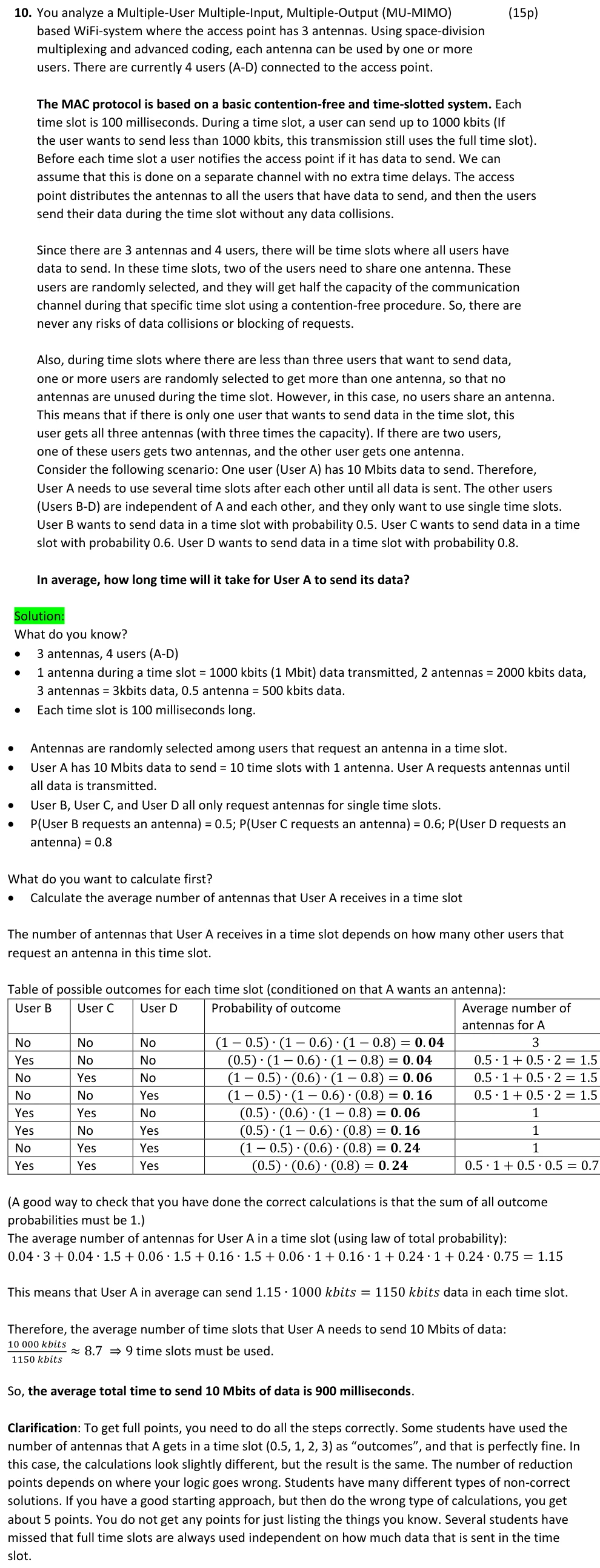
(15p) The national parks in Africa experience lots of problems with illegal hunting. You have been
given the task to help a national park in South Africa with a surveillance monitoring system. A
simple map of the park is shown in the figure below. The area not marked in the map is a
savanna, made up of large expanses of grasses interrupted by scattered shrubs and small trees.
There are several different types of animals, including lion, leopard, rhinoceros, elephant, and
African buffalo (The "Big 5" for hunting), in the park, and they all visit the water holes at regular
times. At other times, they are spread out over the park.
Your task is to design the network architecture for a surveillance system for the park. The
surveillance system should detect potential hunters. If a hunter is detected, a position of the
hunter should be estimated and a warning signal should be sent to the headquarter (placed in
the top right town in the figure).
You have access to all types of sensors, including heat and motion sensors, and various small
microprocessor computers (Raspberry PIs). Also, you have access to trail cameras (small
cameras that takes low-quality images when actuated). All equipment can use all types of
communication technology standards. There is no cellular coverage within the national park (only
in the towns). Starlink is available in South Africa. You have a decent budget for your solution, but
it is preferrable if the system can have low maintenance and be deployed with minimum
interference with the wildlife. Also, the park appreciates low operational costs.
Poäng
15 p
Visa LLM-lösning
Officiell lösning saknas. Följande är ett LLM-förslag som utgår från kursmaterialet. Kontrollera alltid mot föreläsningar och artiklar.
LLM-förslag: bygg ett sensornät med kameror, rörelse-/värmesensorer och Raspberry Pi-noder vid vattenhål och strategiska passager. Noder kan använda ZigBee/BLE mesh eller WiFi-mesh lokalt; där täckning saknas används multi-hop eller DTN/store-and-forward. Ett fåtal gatewayer med Starlink/4G-backhaul skickar larm och bilder till en back-end i molnet. Positionering kan göras med kända nodpositioner, RSSI eller kamera; larmprioriteras och lågenergidrift/solceller minskar underhåll.
(15p) Your task is to design a network system for a company that is investing in a smart
manufacturing environment. In the manufacturing building placed in a city, there will be several
connected mobile robots and connected machines, which all should be connected to a local
cloud server system. The robot intelligence is placed in the cloud, which means that the robots
both send data and receive instructions. The connected machines continuously send process
data that should be analyzed in the cloud. Also, there are workers in the building, who should be
able to monitor both robots and machines using tablets and cell phones.
Your task is to design a suitable network architecture for the manufacturing building. The
company is willing to invest in new networking technologies if necessary. There is a local cloud
server system already deployed.
Poäng
15 p
Visa LLM-lösning
Officiell lösning saknas. Följande är ett LLM-förslag som utgår från kursmaterialet. Kontrollera alltid mot föreläsningar och artiklar.
LLM-förslag: använd ett privat 5G-nät eller WiFi 6/7 inom fabriken, med URLLC för robotstyrning, eMBB för kameror/video och mMTC för maskinsensorer. Placera edge computing nära produktionslinjen för låg latens; koppla mot det lokala cloud-systemet via redundanta backhaul-länkar. Segmentera trafik med slicing/VLAN, prioritera säkerhetskritisk styrning och ge tablets/telefoner åtkomst via ett separat åtkomstnät.
ETSN11 · Riktig tenta
Exempel: tentamen 28 augusti 2025
11 uppgifter · 90 p · officiell lösning där den finns
Dina poäng
0 / 90 p
BetygU
45 p kvar till betyg 3
Gränser: 3 = 45 p · 4 = 60 p · 5 = 75 p · 6 = alla poäng
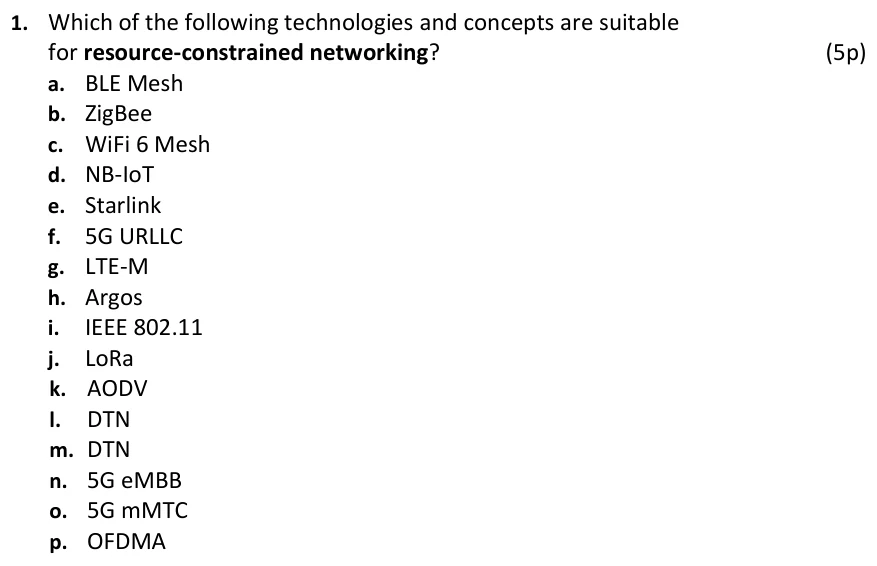
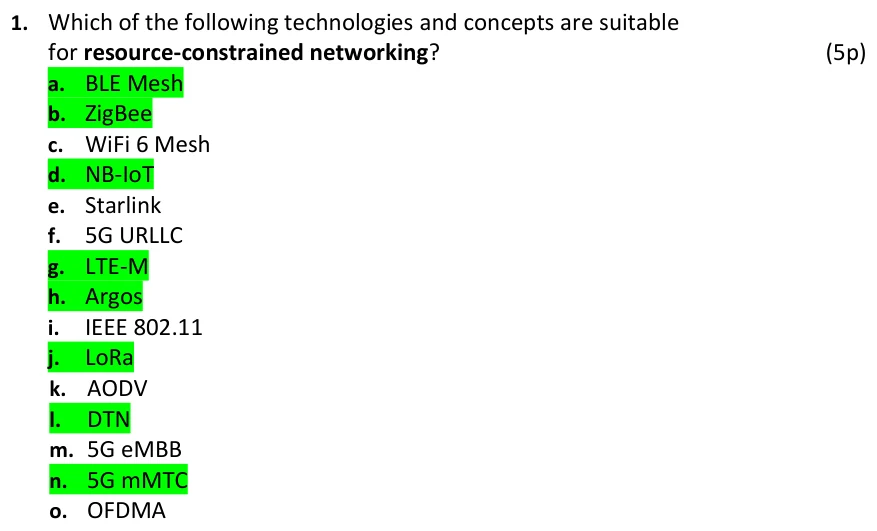
Which of the following technologies and concepts are specifically aimed at time-
critical applications? (5p)
Välj ett eller flera alternativ.
Argos
5G URLLC
LoRa
NB-IoT
DTN
LTE-M
OFDMA
Starlink
WiFi 6 - mesh
Bluetooth Low Energy
Zigbee
5G eMBB
IEEE 802.11p
Licklider
Gossiping
5G mMTC
Totalpoäng: 5
Poäng
5 p
Visa LLM-lösning
Officiell lösning saknas. Följande är ett LLM-förslag som utgår från kursmaterialet. Kontrollera alltid mot föreläsningar och artiklar.
LLM-förslag: de teknologier som i första hand är avsedda för tidskritiska applikationer är 5G URLLC och IEEE 802.11p. DTN, LoRa, NB-IoT, LTE-M, Argos, Starlink, BLE, ZigBee och 5G mMTC är typiskt icke-tidskritiska; OFDMA är en accessmetod, inte en applikationsteknik.
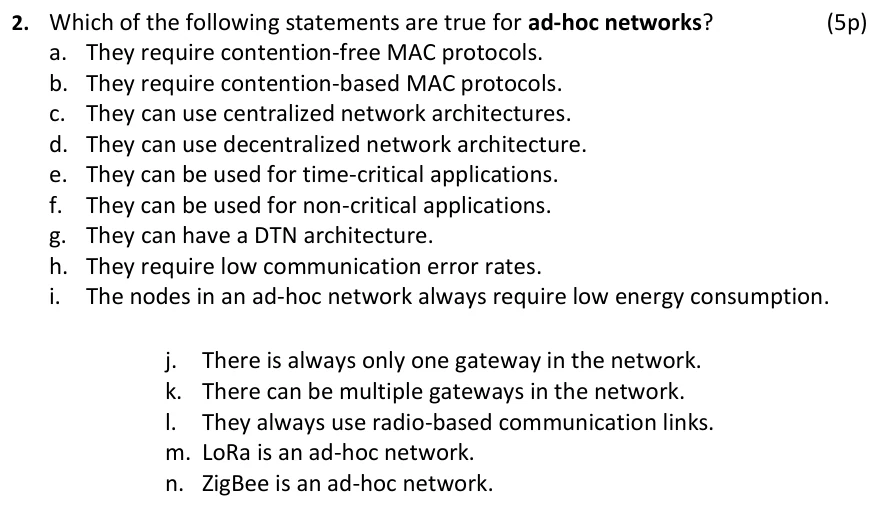
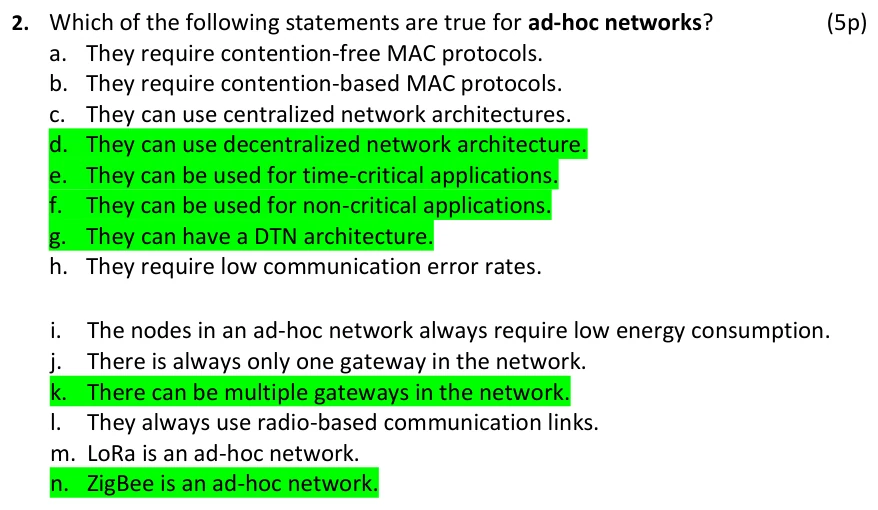
Which of the following statements are true for non-critical applications? (5p)
Välj ett eller flera alternativ.
They require low communication error rates.
They always use devices that require low energy consumption.
They require contention-based MAC protocols.
"Non-critical" means that the application data is not very important for the user.
The network's communication range will be short to save energy.
They can be based on a DTN architecture.
They can use centralized network architectures.
They require contention-free MAC protocols.
"Non-critical" means that the application can tolerate delays and packet loss.
They always use radio-based communication links.
The can use decentralized network architectures.
Totalpoäng: 5
Poäng
5 p
Visa LLM-lösning
Officiell lösning saknas. Följande är ett LLM-förslag som utgår från kursmaterialet. Kontrollera alltid mot föreläsningar och artiklar.
LLM-förslag: icke-tidskritiska applikationer kan tolerera fördröjning och paketförlust, kan använda både centraliserade och decentraliserade arkitekturer och kan använda DTN. De kräver inte nödvändigtvis låg felkvot, låg energi, kort räckvidd eller en viss MAC-typ.
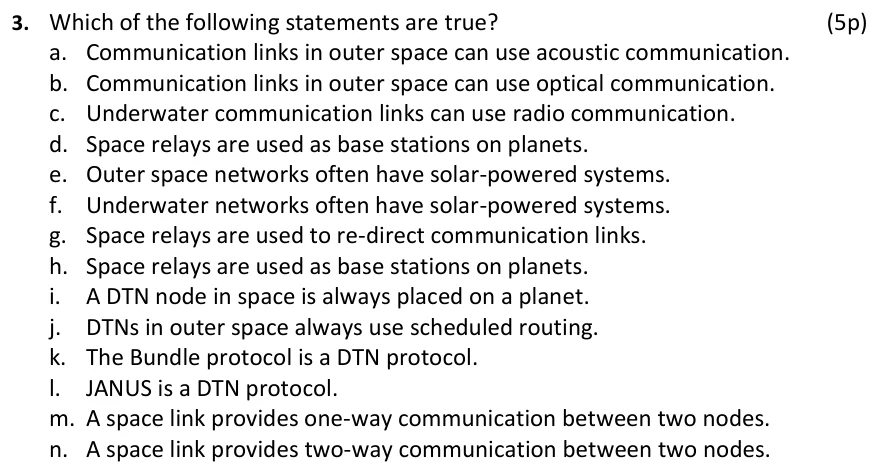
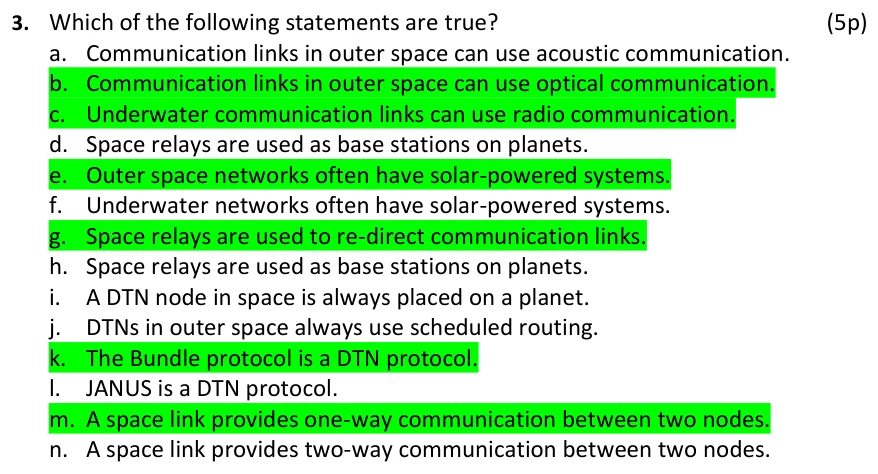
Which of the following statements are true for communication networks in outer space? (5p)
Välj ett eller flera alternativ.
A space link provides full-duplex communication between two nodes.
They can use radio communication links.
They can use acoustic communication links.
They often have solar-powered systems.
Space relays are used as base stations on planets.
A space link provides one-way communication between two nodes.
Space relays are used as DTN nodes.
They often have wind-powered systems.
Licklider is a protocol used in networks in outer space.
They can use DTNs for time-critical applications.
Space relays are used to re-direct communication links.
They can use optical communication links.
Totalpoäng: 5
Poäng
5 p
Visa LLM-lösning
Officiell lösning saknas. Följande är ett LLM-förslag som utgår från kursmaterialet. Kontrollera alltid mot föreläsningar och artiklar.
LLM-förslag: rymdnät kan använda radio och optik, ofta med solceller. En space link är normalt enkelriktad på länknivå, space relays kan vidarebefordra länkar och användas som DTN-noder, och LTP är ett rymdprotokoll. Akustik används inte i rymden, space relays är inte basstationer på planeter, och DTN är inte för tidskritisk trafik.
Describe the purpose, the general architecture and functions for an ad-hoc network. (5p)
Poäng
5 p
Visa LLM-lösning
Officiell lösning saknas. Följande är ett LLM-förslag som utgår från kursmaterialet. Kontrollera alltid mot föreläsningar och artiklar.
LLM-förslag: ett ad-hoc-nät är ett självorganiserande nät utan fast infrastruktur. Noderna upptäcker varandra, kommunicerar direkt och kan vidarebefordra trafik multi-hop. Det kan använda contention-based MAC, routing (t.ex. AODV eller positionsbaserad routing) och kan vara centraliserat endast om en infrastruktur finns; typiskt är det decentraliserat.
Describe the purpose, general architecture and functions for a sensor network. (5p)
Poäng
5 p
Visa LLM-lösning
Officiell lösning saknas. Följande är ett LLM-förslag som utgår från kursmaterialet. Kontrollera alltid mot föreläsningar och artiklar.
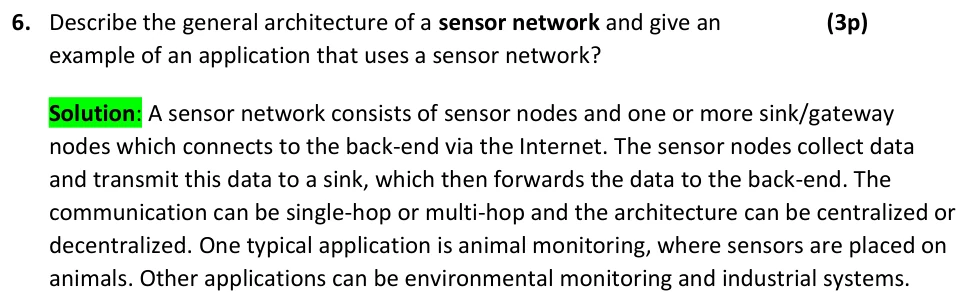
LLM-förslag: ett sensornät består av sensornoder som samlar data och skickar den till en eller flera sinks/gatewayer, som vidarebefordrar till back-end. Nätet kan vara centraliserat eller decentraliserat, single-hop eller multi-hop, och använder energisnåla MAC-/routingprotokoll. Typiska applikationer är miljö-, djur- och industriövervakning.
Describe the main purpose, general network architecture and functions for a CDN. (5p)
Poäng
5 p
Visa LLM-lösning
Officiell lösning saknas. Följande är ett LLM-förslag som utgår från kursmaterialet. Kontrollera alltid mot föreläsningar och artiklar.
LLM-förslag: ett CDN placerar cache-servrar nära användarna. En användare hämtar innehåll från närmaste cache; vid miss går begäran uppåt mot origin-servern och innehållet cachas. Det minskar latens, backhaul-trafik och belastning på origin. Det passar populärt/återanvändbart innehåll som video och webbsidor.
You are designing an MAC protocol that uses a TDD (Time-division duplex) system with
reservations, see an illustration in the figure. A data frame includes three slots (1, 2, 3). Before the
data frame, there is a preamble frame for reservations.
There are three high-priority users (1, 2, 3) that can reserve their corresponding slot when they
have data to send. When a high-priority user has signaled by using its corresponding preamble
slot, this user will sends its data in its coming data slot.
Also, there are low-priority users that can send data when a high-priority user is not using their
data slot. These users send requests that are placed in a queue and handled first-come-first
served. For simplicity, we can assume that this queue is never empty.
For each data frame, each high-priority user reserves its slot with probability 0.4. Each data frame
is independent of each other. (10p)
(a) What is the probability that all slots in a data frame are reserved by the high-priority users?
(2p)
(b) What is the probability that exactly one of the slots in a data frame is used by a low-priority
user? (4p)
(c) What is the average number of data frame slots that can be used by the low-priority users?
(4p)
Poäng
10 p
Visa LLM-lösning
Officiell lösning saknas. Följande är ett LLM-förslag som utgår från kursmaterialet. Kontrollera alltid mot föreläsningar och artiklar.
LLM-förslag: (a) P(alla tre högprioriterade reserverar) = 0,4³ = 0,064. (b) Exakt två högprioriterade: C(3,2)·0,4²·0,6 = 0,288. (c) Varje slot är ledig för lågprioritet med sannolikhet 0,6, så väntevärdet är 3·0,6 = 1,8 slotar per ram.
Consider a simple link layer protocol using Stop-and-wait ARQ. When the sender has transmitted
a data frame, it waits for an ACK. If the sender has not received an ACK within a certain time
period (time out), the sender retransmits the data frame. The probability of a data frame being lost
is p, and the probability that an ACK frame being lost is q.
Assume that p = 0.7 and q= 0.8. Also, assume that the transmission time for a data frame is 0.2
seconds and that the transmission time for an ACK frame is 0.1 seconds. Also, assume that the
time-out period is 1 second. You can ignore all propagation and processing delays, and the sender
has always data to send. (10p)
a. What is the probability that a data frame and the following ACK are correctly received? (2p)
b. What is the average number of data transmissions to successfully send a data frame? (3p)
c. In average, how long time does it take to send 10 correctly received data frames? (2p)
d. What is the efficiency of the data transfer in c? (3p)
Poäng
10 p
Visa LLM-lösning
Officiell lösning saknas. Följande är ett LLM-förslag som utgår från kursmaterialet. Kontrollera alltid mot föreläsningar och artiklar.
LLM-förslag: en lyckad cykel kräver att både data och ACK kommer fram: psucc = 0,3·0,2 = 0,06. Väntevärdet för antalet datatransmissioner är 1/0,06 ≈ 16,67. Tiden per försök beror på om data/ACK går förlorad och på timeout; använd väntevärdet för en cykel (data+ACK+eventuell timeout) och multiplicera med väntevärdet för antalet försök, eller summera sannolikheterna för alla utfall. Exakta tal kräver figurens/formelns tidsantaganden.
Näsudden is a peninsula on the south-west coast of Gotland, see the figure below. Näsudden is
a strategically important area for the Swedish military defense. Also, it is an important area for
large-scale wind power farms, both on land-based and sea-based. The sea-based wind turbines
are placed maximum 10 km from the shore. Näsudden is about 2 km wide (measured from the
east shore to the west shore).
One challenge with wind power farms is that they can cause disturbances for military surveillance
systems. Therefore, the small company Elevated Launch together with Vattenfall, one of the
major Swedish energy production companies, have suggested a solution for this challenge. Their
suggestion is let the wind power turbines be part of the military surveillance system and use the
sea-based wind turbines to extend the surveillance area.
The surveillance system should detect incoming ships, both on and under the water. Also, it
should detect low-flying planes and drones. When a ship or flying object is detected, an alarm
message, including a location and images, should be sent with to the headquarters on land. The
headquarters can then send ships, planes and/or military drones to the specified location.
Your task is to help Elevated Launch and Vattenfall with this surveillance system. You have a
decent budget, since it is part of the Swedish military defense, and you have access to all
available network technology and equipment, for example sensors, buoys, drones, AUV:s, ships,
etc. The wind power turbines have electricity and they are large enough to place equipment on.
The sea-based wind power turbines must used as one part of your surveillance system. (15p)
Poäng
15 p
Visa LLM-lösning
Officiell lösning saknas. Följande är ett LLM-förslag som utgår från kursmaterialet. Kontrollera alltid mot föreläsningar och artiklar.
LLM-förslag: använd vindkraftverkens el och master som plattformar för radar/kameror/akustiska sensorer och bygg ett maskat nät mellan dem. Landbaserade sensorer och havsbaserade bojar/AUV:er kopplas via radio/akustik till vindkraftverken; en eller flera noder har fiber/5G/satellitbackhaul till högkvarteret. Bearbeta larm lokalt (edge) för låg latens och skicka position+bilder. Segmentera militär trafik och planera redundans/energi.
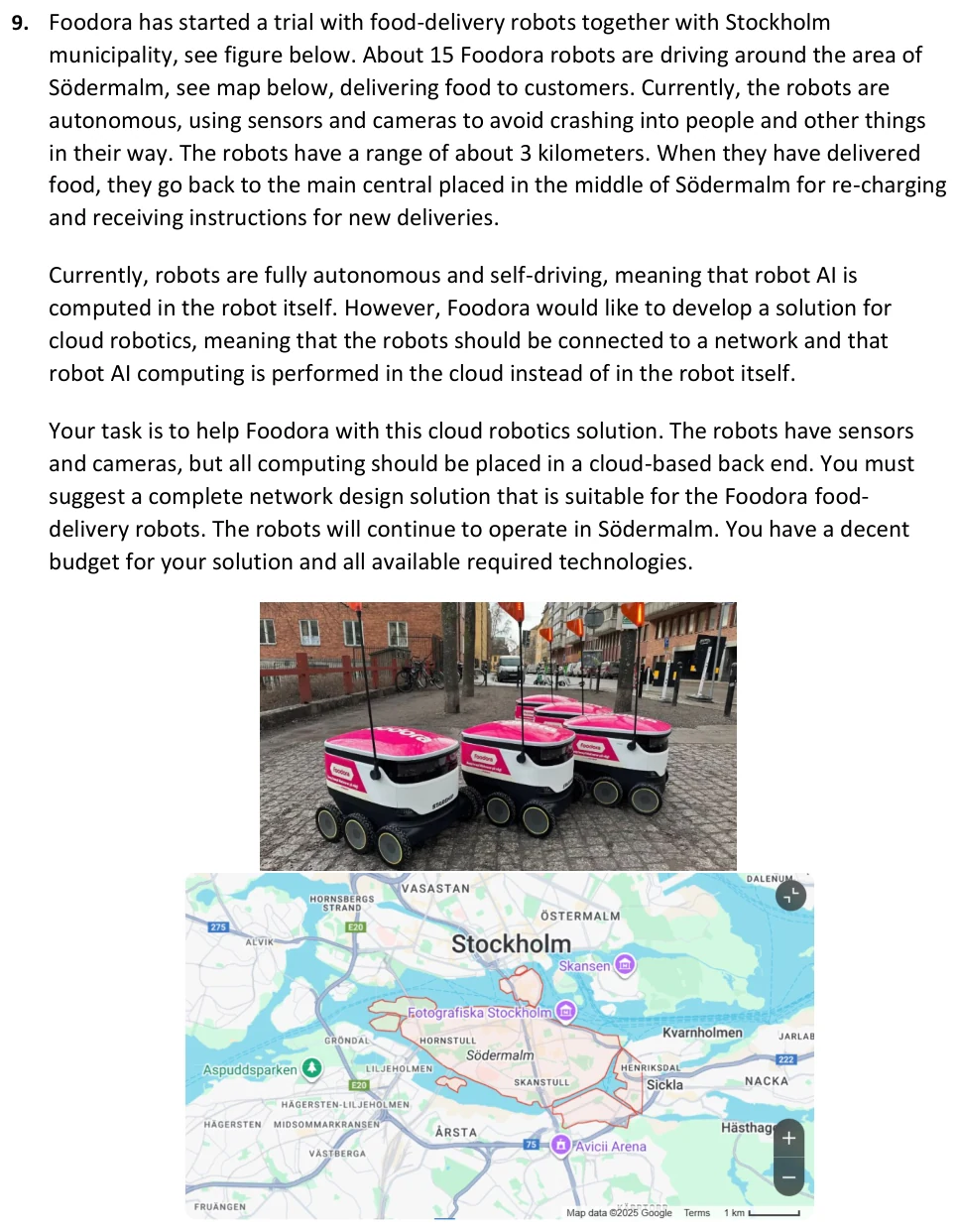
Foodora has started a trial with food-delivery robots together with Stockholm municipality, see
figure below. About 15 Foodora robots are driving around the area of Södermalm, see map
below, delivering food to customers. Currently, the robots are autonomous, using sensors and
cameras to avoid crashing into people and other things in their way. The robots have a range of
about 3 kilometers. When they have delivered food, they go back to the main central placed in
the middle of Södermalm for re-charging and receiving instructions for new deliveries.
Foodora would like to develop a solution for cloud robotics, meaning that the robots should be
connected to a network and that the robot AI computing is performed in the cloud instead of in
the robot itself.
Your task is to help Foodora with this cloud robotics solution. The robots have sensors and
cameras, but all computing should be placed in a cloud-based back-end. You must suggest a
complete network design solution that is suitable for the Foodora food-delivery robots. The robots
will continue to operate in Södermalm. You have a decent budget for your solution and all
available required technologies.
Poäng
15 p
Visa LLM-lösning
Officiell lösning saknas. Följande är ett LLM-förslag som utgår från kursmaterialet. Kontrollera alltid mot föreläsningar och artiklar.
LLM-förslag: bygg ett stadsomfattande 5G/WiFi-nät med edge-servrar i Södermalm. Robottrafik (kamera/positionsdata) går via låglatens-URLLC/slice till edge för AI-beslut; icke-kritisk telemetri kan gå till centralt moln. Använd redundanta länkar, handover mellan celler och lokal fail-safe i roboten. Backhaul via fiber/5G; säkerhetssegmentera robot- och kundtrafik.
ETSN11 · Riktig tenta
Exempel: tentamen 9 april 2026
13 uppgifter · 90 p · officiell lösning där den finns
Dina poäng
0 / 90 p
BetygU
45 p kvar till betyg 3
Gränser: 3 = 45 p · 4 = 60 p · 5 = 75 p · 6 = alla poäng
Which of the following statements are true for LPWAN?
Välj ett eller flera alternativ.
eMBB is a 5G user scenario that fits with LPWAN.
LPWAN is a technology aimed at resource-constrained communication.
NB-IoT is an LPWAN technology.
LPWAN is a technology aimed at time-critical applications.
ZigBee is an LPWAN technology.
WiFi 6/7 is an LPWAN technology.
mMTC is a 5G user scenario that fits with LPWAN.
Totalpoäng: 3
Poäng
3 p
Visa LLM-lösning
Officiell lösning saknas. Följande är ett LLM-förslag som utgår från kursmaterialet. Kontrollera alltid mot föreläsningar och artiklar.
LLM-förslag: LPWAN är avsett för resursbegränsad kommunikation, NB-IoT är LPWAN och mMTC är 5G-scenariot som passar LPWAN-liknande massiv IoT. eMBB är hög datatakt, LPWAN är inte tidskritiskt, och ZigBee/WiFi 6 är inte LPWAN.
Which of the following statements are true for a Centralized network architecture? (3p)
Välj ett eller flera alternativ.
This architecture can be used for non-critical applications.
"Centralized" means that nodes can only communicate with one base station.
"Centralized" means that the nodes are geographically close to each other.
5G uses a centralized network architecture.
"Centralized" means that the nodes organize themselves.
This architecture can be used for time-critical applications.
"Centralized" means that nodes use single-hop communication with the base station.
"Centralized" means that a base station organizes the network.
ZigBee uses a centralized network architecture.
Totalpoäng: 3
Poäng
3 p
Visa LLM-lösning
Officiell lösning saknas. Följande är ett LLM-förslag som utgår från kursmaterialet. Kontrollera alltid mot föreläsningar och artiklar.
LLM-förslag: centraliserad arkitektur kan användas för tidskritiska och icke-tidskritiska applikationer, noder använder single-hop till basstationen, 5G är centraliserat och basstationen organiserar nätet. Det betyder inte att noderna måste vara geografiskt nära eller organisera sig själva; ZigBee mesh är decentraliserat.
Which of the following statements are true for sensor networks? (3p)
Välj ett eller flera alternativ.
There is always one sink in the network.
A centralized network architecture can be used.
Each sensor must have its own MAC/physical address.
A sensor network always uses an DTN architecture.
In a sensor network, there can be some mobile nodes.
The aim of a sensor network is to transport data to a sink.
A decentralized network architecture can be used.
The aim of a sensor network is to communicate with a back-end system.
There are always multiple sinks in the network.
Each sensor must have its own IP-address.
A sensor network can only include stationary nodes.
Totalpoäng: 3
Poäng
3 p
Visa LLM-lösning
Officiell lösning saknas. Följande är ett LLM-förslag som utgår från kursmaterialet. Kontrollera alltid mot föreläsningar och artiklar.
LLM-förslag: sensornät kan vara centraliserade eller decentraliserade, ha mobila noder, och målet är att transportera data till en sink. Varje sensor behöver MAC/fysisk adress. Det behöver inte alltid finnas en eller flera sinks, sensorer behöver inte IP, och DTN är inte ett krav.
Which of the following statements are true for mesh networks. (3p)
Välj ett eller flera alternativ.
LoRa is an example of a technology that uses a mesh network architecture.
A mesh network uses a centralized network architecture.
In a mesh network, all nodes are stationary.
A mesh network is a type of ad-hoc network.
In a mesh network, there can be mobile nodes.
In a mesh network there can be several types of MAC protocols.
ZigBee is an example of a technology that uses a mesh network architecture.
In a mesh network all nodes use the same MAC protocol.
Totalpoäng: 3
Poäng
3 p
Visa LLM-lösning
Officiell lösning saknas. Följande är ett LLM-förslag som utgår från kursmaterialet. Kontrollera alltid mot föreläsningar och artiklar.
LLM-förslag: mesh är en typ av ad-hoc/decentraliserat nät, kan ha mobila noder, flera MAC-protokoll och ZigBee är ett exempel. LoRa är centraliserat, alla noder är inte stationära och alla använder inte samma MAC.
Which of the following statements are true for radio communication links?
Välj ett eller flera alternativ.
High frequencies on Earth generally have a longer range than low frequencies.
Underwater radio links generally use lower frequency spectrum than radio links on Earth.
Underwater radio links generally use similar frequency spectrum as radio links on Earth.
Radio links in space generally use similar frequency spectrum as radio links on Earth.
High frequencies generally can carry more data than low frequencies.
High frequencies generally can carry less data than low frequencies.
High frequencies on Earth generally have a shorter range than low frequencies.
Radio links in space generally use lower frequency spectrum than radio links on Earth.
Radio links in space generally use higher frequency spectrum than radio links on Earth.
Underwater radio links generally use higher frequency spectrum as radio links on Earth.
Totalpoäng: 3
Poäng
3 p
Visa LLM-lösning
Officiell lösning saknas. Följande är ett LLM-förslag som utgår från kursmaterialet. Kontrollera alltid mot föreläsningar och artiklar.
LLM-förslag: undervattensradio använder typiskt lägre frekvenser än markradio, höga frekvenser kan bära mer data men har kortare räckvidd på jorden, och rymdradio använder delvis andra frekvensband. Låga frekvenser ger generellt längre räckvidd på jorden.
Describe the purpose and different architectures for private 5G networks. (5p)
Poäng
5 p
Visa LLM-lösning
Officiell lösning saknas. Följande är ett LLM-förslag som utgår från kursmaterialet. Kontrollera alltid mot föreläsningar och artiklar.
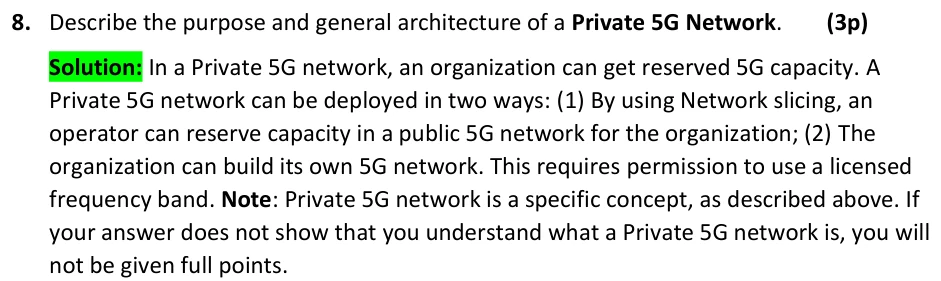
LLM-förslag: ett privat 5G-nät ger en organisation dedikerad kapacitet, kontroll och säkerhet. Det kan byggas som ett eget nät med egen infrastruktur/licens eller som en slice i en operatörs publika 5G. Arkitekturen omfattar 5G-basstationer, lokal core/edge, backhaul och anslutning till organisationens IT/OT.
Describe the purpose and general architecture of LoRa networks. (5p)
Poäng
5 p
Visa LLM-lösning
Officiell lösning saknas. Följande är ett LLM-förslag som utgår från kursmaterialet. Kontrollera alltid mot föreläsningar och artiklar.
LLM-förslag: LoRa är en LPWAN-teknik med lång räckvidd och låg energi. Ett LoRaWAN består av end devices, gateways och en network server/application server; gatewayerna vidarebefordrar paket till servern. Enheten kan använda Class A/B/C med olika mottagningsfönster; nätet är centraliserat och använder olicensierat band.
Shortly describe a network architecture for connecting a moon village with the Internet on Earth.
For full points, you need to include the most important parts of this network architecture. (5p)
Poäng
5 p
Visa LLM-lösning
Officiell lösning saknas. Följande är ett LLM-förslag som utgår från kursmaterialet. Kontrollera alltid mot föreläsningar och artiklar.
LLM-förslag: bygg ett lokalt månnät (WiFi/mesh) för habitat och rovers, koppla det via en gateway/space relay till jorden med radio/optiska länkar. Använd DTN med Bundle/LTP och schemalagda kontakter för de långa fördröjningarna. Lokal edge/cache hanterar data; backhaul till jorden sker via en eller flera satelliter/reläer.
You are developing a Massive MIMO system. In Massive MIMO, a type of time-slotted system
based on so called coherence intervals is used. For each coherence interval, there are a limited
number of so called pilots.
A user needs a pilot in order to be able to send data. Each coherence interval is 10 milliseconds,
and there are 4 users that submit requests for pilots independent of each other. The probability
that a specific user submits a request for a pilot in the next coherence interval is 0.25.
If there are more users requests than pilots when a new coherence interval starts, the pilots are
distributed randomly among the users. If a user does not get a pilot in a coherence interval, the
user backs off and continues to send requests with the same probability as before. (10p)
(a) Assume that we have decided to have 3 pilots in each coherence interval. What is the
probability that a user gets a pilot if the user submits a request? (4p)
(b) Assume that we have two design choices:
Alternative 1: 2 pilots in each coherence interval, where each pilot correspond to maximum 300
bits of transmitted data.
Alternative 2: 3 pilots in each coherence interval, where each pilot correspond to maximum 200
bits of transmitted data.
Assume that a user has 500 bits of data to send. Which alternative will give this user the lowest
average time for sending this data? (6p)
Poäng
10 p
Visa LLM-lösning
Officiell lösning saknas. Följande är ett LLM-förslag som utgår från kursmaterialet. Kontrollera alltid mot föreläsningar och artiklar.
LLM-förslag: (a) Låt X vara antalet övriga användare som begär pilot. X~Bin(3,0,25). En användare får pilot om X≤2, plus 3/4 chans om X=3. Detta ger ungefär 0,996. (b) Med 2 piloter är sannolikheten att en begärande användare får pilot ungefär 0,945; med 3 piloter ungefär 0,996. En användare med 500 bitar behöver 2 lyckade sändningar à 300 bitar (alt. 1) eller 3 à 200 bitar (alt. 2). Väntevärdet för antal coherence-intervall per lyckad sändning är 1/(0,25·q). Det ger cirka 8,46 intervall (0,085 s) för alternativ 1 och 12,05 intervall (0,120 s) för alternativ 2. Alternativ 1 är alltså snabbast.
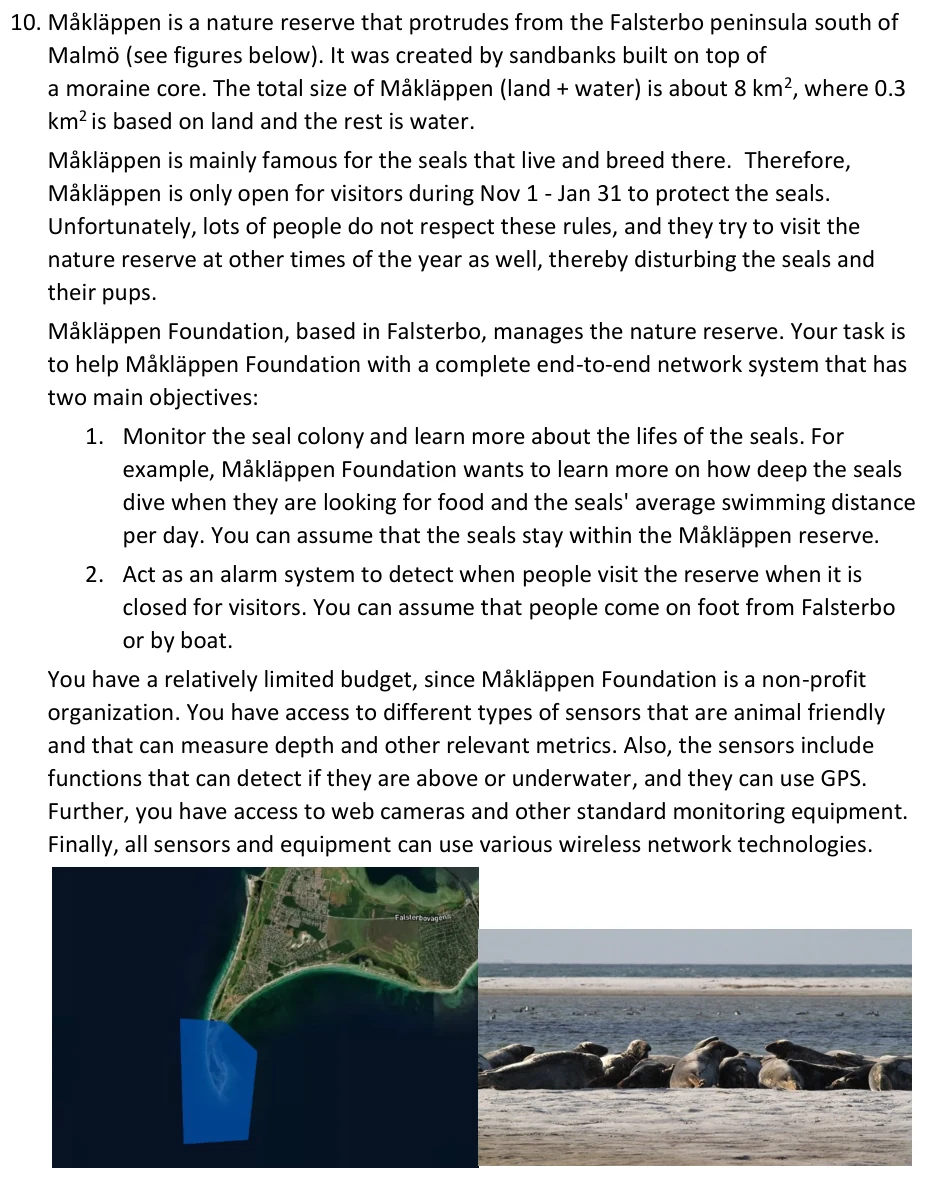
You have been asked to help the Swedish Defense Research Agency (FOI). The Swedish
government has decided to upgrade the defense system around the Swedish island Gotland (see
pdf-resource 12_Gotland for more information). Therefore, FOI has started a project that will
develop a surveillance system for the area (both in the air and underwater) around Gotland.
The surveillance system should detect incoming unwanted underwater or flying moving objects,
for example foreign submarines, Autonomous Underwater Vehicles (AUVs) or drones. When an
unwanted object is detected, an alarm signal should be sent to the command center placed in
Visby, on the west coast of Gotland. With the alarm signal, there should be an estimated position
of the unwanted object. When an alarm is received, the Swedish Navy will send helicopters and
ships to the area where the object was detected.
Your task is to propose a complete network system design for this surveillance system. Since
Gotland is a rather large island, you can focus on the areas around the small island
Östergarnsholm, shown in the image below (The area is marked with yellow in the pdf-resource
12_Gotland). Östergarnsholm is a small, flat island about 4 km from the east coast of Gotland.
The maximum depth of the sea within 1 km radius of the island is about 30 m. On the south tip of
the island, there is a meteorological tower. In addition, there is meteorological measurement
equipment placed in the sea around the island, see the image. Also, there is a lighthouse on the
island.
You are quite flexible regarding infrastructures and equipment, and FOI has a decent budget for
the project.
Poäng
15 p
Visa LLM-lösning
Officiell lösning saknas. Följande är ett LLM-förslag som utgår från kursmaterialet. Kontrollera alltid mot föreläsningar och artiklar.
LLM-förslag: använd en kombination av radar/kameror på Östergarnsholm och master, akustiska sensorer/bojar under vattnet samt AUV:er. Bygg ett lokalt mesh/radio-nät mellan ön, bojar och master; akustiska undervattenslänkar till ytbojar. Edge-dator på ön fusionerar sensordata och skickar larm med position/bilder via fiber/5G/satellit till Visby. Planera redundans, tidssynk och energiförsörjning.
Your task is to help Helsingborg West Harbour with their project on self-driving trucks. The trucks
will move containers within the harbour area. The trucks will be controlled by a software
application placed in a back-end server. The software application will send instructions to the
trucks about their path trajectory, so that the trucks' movements are optimized. The trucks will
continuously send information about their current position to the software application. As a fall-
back solution, the trucks will have their own internal collision-avoidance mechanism so that they
do not collide into each other or other things.
Your task is to propose a complete network system design for this self-driving application. Your
solution should be based on well-known commercial technologies. The image below shows
Helsingborg West Harbour.
Poäng
15 p
Visa LLM-lösning
Officiell lösning saknas. Följande är ett LLM-förslag som utgår från kursmaterialet. Kontrollera alltid mot föreläsningar och artiklar.
LLM-förslag: använd ett privat 5G/WiFi 6-nät i hamnen med edge-server nära terminalen. Truckarna får låglatenslänk för positionsdata och körinstruktioner (URLLC/slice), med redundanta accesspunkter och fail-safe lokalt i trucken. Kameror/sensorer kan använda eMBB; backhaul via fiber/5G till det centrala back-end-systemet. Segmentera trafik och planera täckning över containterytan.
Övningsprov
Genererade övningsprov
Frågorna är AI-genererade från kursmaterialet och följer samma bredd och poängfördelning som tentorna. De är inte officiella tentor – kontrollera alltid mot kursmaterialet.
ETSN11 · Genererad övning
Övningsprov A
9 uppgifter · 90 p · AI-genererad övning · kontrollera mot kursmaterialet
Dina poäng
0 / 90 p
BetygU
45 p kvar till betyg 3
Gränser: 3 = 45 p · 4 = 60 p · 5 = 75 p · 6 = alla poäng
Övningsprov: frågorna är AI-genererade från kursmaterialet. De är inte officiella tentafrågor – kontrollera alltid mot föreläsningar och artiklar.
Which of the following statements are true for a centralized network architecture? (6p)
The access point/base station controls medium access.
Nodes normally communicate with the access point using single-hop links.
5G and LoRa networks are examples of centralized architectures.
Nodes organize themselves without any central controller.
A centralized architecture always requires multi-hop communication.
ZigBee mesh is a purely centralized architecture.
A gateway is never needed in a centralized network.
The base station can coordinate when nodes transmit.
Poäng
6 p
Visa lösning
True: 1, 2, 3, 8. False: 4, 5, 6, 7.
Centralized means that a base station/AP coordinates the nodes; direct single-hop access is typical. ZigBee mesh is decentralized, and a gateway is still needed for Internet connectivity.
A server receives requests as a Poisson process with λ = 8 requests/s. Service times are exponential with mean 0.08 s. Model it as M/M/1 with an unlimited queue.
What is the utilization?
What is the throughput?
What is the average number of requests in the system?
Scenario: A 12-storey hospital wants to track about 1000 medical carts. The most important requirement is to know which floor a cart is on. The building has WiFi and wired Internet. Propose an end-to-end network system and motivate your choices.
Poäng
15 p
Visa lösning
Example solution
Use a low-power indoor technology such as BLE or ZigBee with anchors on each floor; tags on the carts.
Anchors form a centralized or mesh network and forward data to floor gateways.
Gateways use the hospital LAN/WiFi as backhaul to a cloud/back-end service.
Floor-level accuracy is sufficient, so RSSI/trilateration can be used; no GPS is needed indoors.
Scenario: A farm wants to monitor 20 cows with hourly position updates. The pasture is large and cellular coverage is weak. Data should reach a cloud service. Propose a complete network system.
Poäng
15 p
Visa lösning
Example solution
Use battery/solar-powered LPWAN tags (LoRa or NB-IoT if coverage exists).
Deploy a LoRa gateway with backhaul (fiber/4G/satellite) to the Internet.
Send data to a cloud back-end for storage and visualization.
Use duty cycling/energy-efficient MAC; hourly updates are non-critical.
If no gateway coverage, use a DTN/mobile gateway for store-and-forward.
Källa: Low-Power-Wide-Area-Networks-LPWAN.pdf s. 4 · Artikel: Rashmi Sharan Sinha
ETSN11 · Genererad övning
Övningsprov B
9 uppgifter · 90 p · AI-genererad övning · kontrollera mot kursmaterialet
Dina poäng
0 / 90 p
BetygU
45 p kvar till betyg 3
Gränser: 3 = 45 p · 4 = 60 p · 5 = 75 p · 6 = alla poäng
Övningsprov: frågorna är AI-genererade från kursmaterialet. De är inte officiella tentafrågor – kontrollera alltid mot föreläsningar och artiklar.
Four devices use slotted ALOHA. In each slot, A and B transmit with probability 0.2 and C and D with probability 0.3, independently. Assume a frame is successful only if exactly one device transmits.
What is the probability that a slot is empty?
What is the probability of exactly one transmission?
Scenario: Monitor oil spills around offshore platforms. You have underwater sensors, AUVs, small boats and a cloud server. Design an end-to-end system.
Poäng
15 p
Visa lösning
Example solution
Use acoustic links for long-range underwater sensor data; optical links for short high-rate AUV transfers.
JANUS can provide an interoperable acoustic MAC.
AUVs collect data from sensors and carry it to surface gateways/boats (DTN/store-and-forward).
Surface nodes use satellite or cellular backhaul to the cloud.
Localization cannot rely on GPS underwater; use acoustic ranging or known positions.
Scenario: Environmental sensors are spread over a remote region with no terrestrial network. Design a satellite-based monitoring system with low maintenance and low energy use.
Poäng
15 p
Visa lösning
Example solution
Use Argos or a similar low-rate satellite IoT system for small, infrequent sensor messages.
Use Starlink or another broadband satellite link for a local gateway if higher data rates are needed.
Solar panels and batteries plus DRX/duty cycling reduce energy use.
Satellite links provide backhaul to a cloud back-end.
Store-and-forward/DTN can handle intermittent contacts.
A ground station sends a 10 kbit message to the Moon over a 1 Mbit/s link. The distance is 384,400 km and the signal travels at 3·108 m/s. Ignore processing and queueing.
A queueing system has at most 3 requests. Measurements give P(0)=0.19, P(1)=0.23, P(2)=0.26 and P(3)=0.32. New requests arrive with λ = 4 requests/s and are blocked if the system is full. Service rate is μ = 5 requests/s.
What is the average number of requests in the system?
What is the blocking probability?
What is the effective throughput?
What is the average response time for accepted requests?
Scenario: A humanitarian emergency has destroyed the terrestrial network. Relief teams need local communication and a link to the Internet. Design a network architecture.
Poäng
15 p
Visa lösning
Example solution
Deploy a rapidly installable WiFi/mesh network for local teams.
Use satellite backhaul (Starlink/VSAT) at a gateway/portal.
Use DTN/store-and-forward for intermittent links and delay-tolerant data.
Prioritize voice, messaging and sensor data; use edge/fog processing locally.
Power via generators/solar and plan for limited capacity.
Källa: Delay-tolerant-networking.pdf s. 1 · Artikel: Forrest Warthman
Scenario: A factory wants private 5G for AGVs and robots with low latency, plus massive sensor data and video. Design the network and explain the role of edge computing.
Poäng
15 p
Visa lösning
Example solution
Deploy a private 5G network or a dedicated slice of a public 5G network.
Use URLLC for robot control and eMBB for video; mMTC for sensors.
Place edge computing near the factory to reduce latency.
Use a local backhaul and redundant links; integrate with the factory IT/OT network.
Plan security, isolation and coverage indoors.
Källa: Cellular-Mobile-Networks.pdf s. 1 · Artikel: Hyoungju Ji
ETSN11 · Genererad övning
Övningsprov D
9 uppgifter · 90 p · AI-genererad övning · kontrollera mot kursmaterialet
Dina poäng
0 / 90 p
BetygU
45 p kvar till betyg 3
Gränser: 3 = 45 p · 4 = 60 p · 5 = 75 p · 6 = alla poäng
Övningsprov: frågorna är AI-genererade från kursmaterialet. De är inte officiella tentafrågor – kontrollera alltid mot föreläsningar och artiklar.
Scenario: A city district wants high-density public WiFi and 5G for residents, cameras and buses. Design the access, backhaul and back-end architecture.
Poäng
15 p
Visa lösning
Example solution
Use WiFi 6/7 access points and 5G small cells for high-density coverage.
Connect access points via fiber/radio backhaul to a core network.
Use edge servers for latency-sensitive video analytics; cloud for storage.
Separate public, camera and bus traffic with VLANs/slicing and security policies.
Plan capacity and interference; use licensed spectrum for 5G.
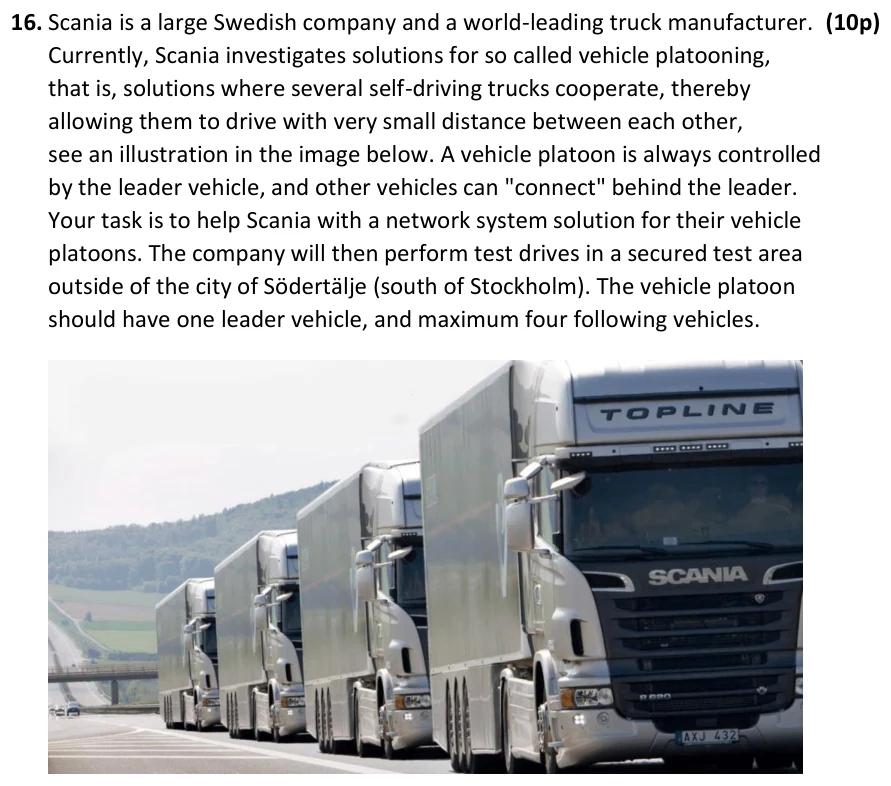
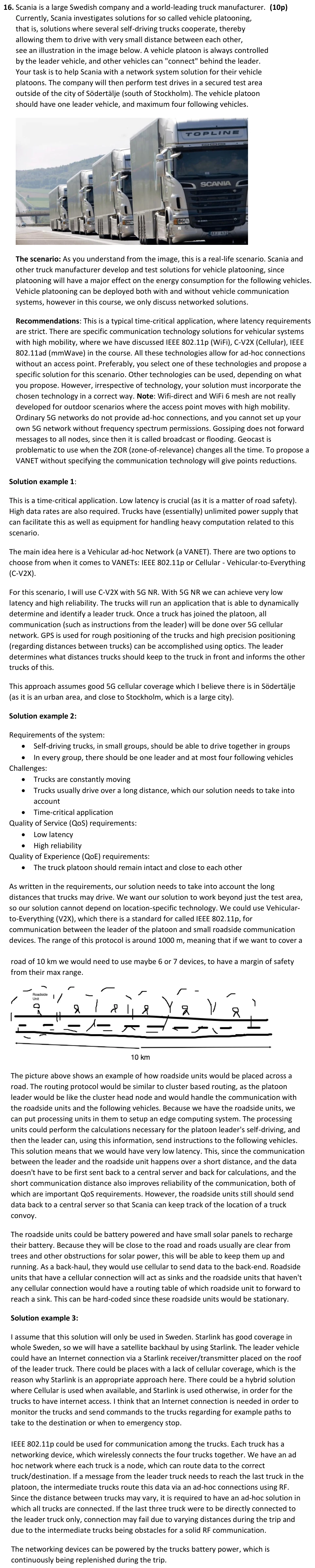
Scenario: Scania tests truck platooning with one leader and up to four followers. The trucks need low-latency, reliable communication. Propose a network design.
Poäng
15 p
Visa lösning
Example solution
Use 5G URLLC or a dedicated short-range radio link for platoon control.
Use V2V links between trucks and a cellular backhaul to the fleet backend.
Keep safety-critical control local/edge to minimize latency.
Add redundancy and fail-safe behavior for connectivity loss.
Use mMTC/eMBB for non-critical telemetry and video.
Three devices use slotted ALOHA with transmission probabilities 0.1, 0.2 and 0.3 in each slot, independently. A slot succeeds only with exactly one transmission.
A finite queue has P(0)=0.1, P(1)=0.2, P(2)=0.3 and P(3)=0.4. Arrivals are λ=3 requests/s and blocked when the system is full. Service rate is μ=4 requests/s.
What is the average number in the system?
What is the blocking probability?
What is the effective throughput?
What is the average response time for accepted requests?
Scenario: A future Mars base needs Internet-like communication with Earth and local communication between habitats and rovers. Design the network.
Poäng
15 p
Visa lösning
Example solution
Use deep-space radio/optical links with DTN and LTP.
Use space relays to handle occultation and long delays.
Build a local Mars network (WiFi/mesh) for habitats and rovers.
Use store-and-forward and scheduled contacts; TCP is not suitable end-to-end.
Plan for solar power and high latency; use local caching/edge computing.
Källa: Interplanetary-networks.pdf s. 21
Begreppsträning
Matcha begrepp, definitioner och användning
Varje runda drar nya begrepp och blandar in extra alternativ. Du kan inte gissa dig fram till sista paret.
Poäng 0Streak 0Bästa streak 0Klara 0 / 0
Frågor
Begrepp
Alla frågor
Hitta rätt uppgift
Filtrera på ämne och välj om AI-genererade övningsprov ska ingå. De ingår som standard.
Filtrera på ämneVälj ett eller flera ämnen – frågor som matchar minst ett visas.
Visar 132 av 132 frågor
Tenta 2023-10-25 · Uppgift 13 p
Riktig tenta
Uppgift 1
Which of the following statements are true for a Decentralized
Tenta 2023-10-25 · Uppgift 23 p
Riktig tenta
Uppgift 2
Which of the following statements are true for WiFi 6 mesh?
Tenta 2023-10-25 · Uppgift 33 p
Riktig tenta
Uppgift 3
Which of the following statements are true for NB-IoT??
Tenta 2023-10-25 · Uppgift 43 p
Riktig tenta
Uppgift 4
Which of the following statements are true?
Tenta 2023-10-25 · Uppgift 53 p
Riktig tenta
Uppgift 5
Which of the following statements are true??
Tenta 2023-10-25 · Uppgift 63 p
Riktig tenta
Uppgift 6
Describe the general architecture of a sensor network and give an
Tenta 2023-10-25 · Uppgift 72 p
Riktig tenta
Uppgift 7
What is fog computing?
Tenta 2023-10-25 · Uppgift 83 p
Riktig tenta
Uppgift 8
Describe the purpose and general architecture of a Private 5G Network.
Tenta 2023-10-25 · Uppgift 93 p
Riktig tenta
Uppgift 9
Describe a routing algorithm that can be suitable for a vehicular
Tenta 2023-10-25 · Uppgift 104 p
Riktig tenta
Uppgift 10
Explain what the procedure frequency hopping is, and explain why it is
Tenta 2023-10-25 · Uppgift 1110 p
Riktig tenta
Uppgift 11
You are doing performance modeling of a web server system. You
Tenta 2023-10-25 · Uppgift 128 p
Riktig tenta
Uppgift 12
You are modelling a very simple MAC protocol. A device can send a data
Tenta 2023-10-25 · Uppgift 134 p
Riktig tenta
Uppgift 13
You are designing a communication link from the Earth to the Moon. The
Tenta 2023-10-25 · Uppgift 148 p
Riktig tenta
Uppgift 14
You are investigating the performance of the queueing system shown in
Tenta 2023-10-25 · Uppgift 1510 p
Riktig tenta
Uppgift 15
The Skåne University Hospital (SUS) in Lund wants you to design a
Tenta 2023-10-25 · Uppgift 1610 p
Riktig tenta
Uppgift 16
Scania is a large Swedish company and a world-leading truck manufacturer.
Tenta 2023-10-25 · Uppgift 1710 p
Riktig tenta
Uppgift 17
Your task is to help the polar research station NIPR, placed in the small
Tenta 2024-11-01 · Uppgift 13 p
Riktig tenta
Uppgift 1
Which of the following statements are true for Bluetooth Low Energy (BLE)?
Tenta 2024-11-01 · Uppgift 23 p
Riktig tenta
Uppgift 2
Which of the following statements are true for Centralized network
Tenta 2024-11-01 · Uppgift 33 p
Riktig tenta
Uppgift 3
Which of the following statements are true for sensor networks?
Tenta 2024-11-01 · Uppgift 43 p
Riktig tenta
Uppgift 4
Which of the following statements are true for Delay- and Disruption Tolerant
Tenta 2024-11-01 · Uppgift 53 p
Riktig tenta
Uppgift 5
Which of the following statements are true for wireless underwater networks?
Tenta 2024-11-01 · Uppgift 65 p
Riktig tenta
Uppgift 6
Describe the general network architecture and main protocols for WiFi 6/7 mesh.
Tenta 2024-11-01 · Uppgift 75 p
Riktig tenta
Uppgift 7
What is a Cloud-based RAN (C-RAN)? Also, describe the general system
Tenta 2024-11-01 · Uppgift 85 p
Riktig tenta
Uppgift 8
Describe what a Space Relay is and when it is used.
Tenta 2024-11-01 · Uppgift 915 p
Riktig tenta
Uppgift 9
You are analyzing a client-server application, and you use a queueing model
Tenta 2024-11-01 · Uppgift 1015 p
Riktig tenta
Uppgift 10
You analyze a Multiple-User Multiple-Input, Multiple-Output (MU-MIMO)
Tenta 2024-11-01 · Uppgift 1115 p
Riktig tenta
Uppgift 11
The national parks in Africa experience lots of problems with illegal hunting. You have been given
Tenta 2024-11-01 · Uppgift 1215 p
Riktig tenta
Uppgift 12
Your task is to help Scania with their new project that investigates mobile robots for “last
Tenta 2025-10-30 · Uppgift 15 p
Riktig tenta
Uppgift 1
Which of the following technologies and concepts are suitable
Tenta 2025-10-30 · Uppgift 25 p
Riktig tenta
Uppgift 2
Which of the following statements are true for ad-hoc networks?
Tenta 2025-10-30 · Uppgift 35 p
Riktig tenta
Uppgift 3
Which of the following statements are true?
Tenta 2025-10-30 · Uppgift 45 p
Riktig tenta
Uppgift 4
Describe the purpose, architecture and main functions of Bluetooth.
Tenta 2025-10-30 · Uppgift 55 p
Riktig tenta
Uppgift 5
Describe the main functions for DTNs and describe an example of a
Tenta 2025-10-30 · Uppgift 65 p
Riktig tenta
Uppgift 6
Describe the main purpose and functions of Backhaul links and give at
Tenta 2025-10-30 · Uppgift 715 p
Riktig tenta
Uppgift 7
You design a wireless access network including a base station and several user devices,
Tenta 2025-10-30 · Uppgift 815 p
Riktig tenta
Uppgift 8
You are designing a new application protocol. The application protocol receives data
Tenta 2025-10-30 · Uppgift 915 p
Riktig tenta
Uppgift 9
Foodora has started a trial with food-delivery robots together with Stockholm
Tenta 2025-10-30 · Uppgift 1015 p
Riktig tenta
Uppgift 10
Måkläppen is a nature reserve that protrudes from the Falsterbo peninsula south of
Exempel: tentamen 10 april 2024 · Uppgift 13 p
Exempel på inlämnad tenta
Uppgift 1
Which of the following statements are true for LoRa? (3p) Välj ett eller flera alternativ. It is a network technology aimed at non-critical applications. Animal and environmental monitoring are typical applications of this technology. It us…
Exempel: tentamen 10 april 2024 · Uppgift 23 p
Exempel på inlämnad tenta
Uppgift 2
Which of the following statements are true for a Centralized network architecture? (3p) Välj ett eller flera alternativ. "Centralized" means that a gateway organizes the network. This architecture can be used for time-critical applications.…
Exempel: tentamen 10 april 2024 · Uppgift 33 p
Exempel på inlämnad tenta
Uppgift 3
Which of the following statements are true? (3p) Välj ett eller flera alternativ. Radio communication underwater works well when high frequency bands are used. Beamforming can be used to increase the radio range. Higher frequency bands mean…
Exempel: tentamen 10 april 2024 · Uppgift 43 p
Exempel på inlämnad tenta
Uppgift 4
Which of the following statements are true for resource-constrained networking? (3p) Välj ett eller flera alternativ. LoRa is suitable for resource-constrained networking. Gossiping is a MAC protocol aimed for resource-constrained networkin…
Exempel: tentamen 10 april 2024 · Uppgift 53 p
Exempel på inlämnad tenta
Uppgift 5
Which of the following statements are true for sensor networks? (3p) Välj ett eller flera alternativ. A decentralized network architecture can be used. The aim of a sensor network is to communicate with a back-end system. There are always m…
Exempel: tentamen 10 april 2024 · Uppgift 65 p
Exempel på inlämnad tenta
Uppgift 6
Describe a MAC protocol that can be used for systems where devices need to save energy. (5p)
Exempel: tentamen 10 april 2024 · Uppgift 74 p
Exempel på inlämnad tenta
Uppgift 7
What is a mesh network? (4p)
Exempel: tentamen 10 april 2024 · Uppgift 83 p
Exempel på inlämnad tenta
Uppgift 8
What is a CDN and when is it suitable? (3p)
Exempel: tentamen 10 april 2024 · Uppgift 93 p
Exempel på inlämnad tenta
Uppgift 9
What is mMTC and what type of network systems is it aimed at? (3p)
Exempel: tentamen 10 april 2024 · Uppgift 108 p
Exempel på inlämnad tenta
Uppgift 10
We would like to design an edge computing server for a 5G base station. We analyze the traffic in the cell and find that users in total place requests according to an exponential distribution with average 10 requests/second (we can assume t…
Exempel: tentamen 10 april 2024 · Uppgift 1110 p
Exempel på inlämnad tenta
Uppgift 11
We develop a wireless radio access system with a time-slotted contention based MAC protocol. Nodes can send data packets using one of 3 time slots. We model the system as an M/M/3 system without queue (Erlang system). The average arrival ra…
Exempel: tentamen 10 april 2024 · Uppgift 126 p
Exempel på inlämnad tenta
Uppgift 12
Consider the ad-hoc network in the figure below. Dashed lines indicate nodes are within transmission range of each other. The network uses so called contention-based greedy forwarding. With greedy forwarding, a sender node selects the forwa…
Exempel: tentamen 10 april 2024 · Uppgift 136 p
Exempel på inlämnad tenta
Uppgift 13
Consider a simple link layer protocol using Stop-and-wait ARQ. When the sender has transmitted a data frame, it waits for an ACK. If the sender has not received an ACK within a certain time period (time out), the sender retransmits the data…
Exempel: tentamen 10 april 2024 · Uppgift 1415 p
Exempel på inlämnad tenta
Uppgift 14
(15p) The national parks in Africa experience lots of problems with illegal hunting. You have been given the task to help a national park in South Africa with a surveillance monitoring system. A simple map of the park is shown in the figure…
Exempel: tentamen 10 april 2024 · Uppgift 1515 p
Exempel på inlämnad tenta
Uppgift 15
(15p) Your task is to design a network system for a company that is investing in a smart manufacturing environment. In the manufacturing building placed in a city, there will be several connected mobile robots and connected machines, which …
Exempel: tentamen 28 augusti 2025 · Uppgift 15 p
Exempel på inlämnad tenta
Uppgift 1
Which of the following technologies and concepts are specifically aimed at time- critical applications? (5p) Välj ett eller flera alternativ. Argos 5G URLLC LoRa NB-IoT DTN LTE-M OFDMA Starlink WiFi 6 - mesh Bluetooth Low Energy Zigbee 5G e…
Exempel: tentamen 28 augusti 2025 · Uppgift 25 p
Exempel på inlämnad tenta
Uppgift 2
Which of the following statements are true for non-critical applications? (5p) Välj ett eller flera alternativ. They require low communication error rates. They always use devices that require low energy consumption. They require contention…
Exempel: tentamen 28 augusti 2025 · Uppgift 35 p
Exempel på inlämnad tenta
Uppgift 3
Which of the following statements are true for communication networks in outer space? (5p) Välj ett eller flera alternativ. A space link provides full-duplex communication between two nodes. They can use radio communication links. They can …
Exempel: tentamen 28 augusti 2025 · Uppgift 45 p
Exempel på inlämnad tenta
Uppgift 4
Describe the purpose, the general architecture and functions for an ad-hoc network. (5p)
Exempel: tentamen 28 augusti 2025 · Uppgift 55 p
Exempel på inlämnad tenta
Uppgift 5
Describe the purpose, general architecture and functions for a sensor network. (5p)
Exempel: tentamen 28 augusti 2025 · Uppgift 65 p
Exempel på inlämnad tenta
Uppgift 6
Describe the main purpose, general network architecture and functions for a CDN. (5p)
Exempel: tentamen 28 augusti 2025 · Uppgift 710 p
Exempel på inlämnad tenta
Uppgift 7
You are designing an MAC protocol that uses a TDD (Time-division duplex) system with reservations, see an illustration in the figure. A data frame includes three slots (1, 2, 3). Before the data frame, there is a preamble frame for reservat…
Exempel: tentamen 28 augusti 2025 · Uppgift 810 p
Exempel på inlämnad tenta
Uppgift 8
You are designing a video streaming server. You model the server as a single-server queueing system with an unlimited queue. Users send requests to the server according to a Poisson process with average 7 requests per second. The average se…
Exempel: tentamen 28 augusti 2025 · Uppgift 910 p
Exempel på inlämnad tenta
Uppgift 9
Consider a simple link layer protocol using Stop-and-wait ARQ. When the sender has transmitted a data frame, it waits for an ACK. If the sender has not received an ACK within a certain time period (time out), the sender retransmits the data…
Exempel: tentamen 28 augusti 2025 · Uppgift 1015 p
Exempel på inlämnad tenta
Uppgift 10
Näsudden is a peninsula on the south-west coast of Gotland, see the figure below. Näsudden is a strategically important area for the Swedish military defense. Also, it is an important area for large-scale wind power farms, both on land-base…
Exempel: tentamen 28 augusti 2025 · Uppgift 1115 p
Exempel på inlämnad tenta
Uppgift 11
Foodora has started a trial with food-delivery robots together with Stockholm municipality, see figure below. About 15 Foodora robots are driving around the area of Södermalm, see map below, delivering food to customers. Currently, the robo…
Exempel: tentamen 9 april 2026 · Uppgift 13 p
Exempel på inlämnad tenta
Uppgift 1
Which of the following statements are true for LPWAN? Välj ett eller flera alternativ. eMBB is a 5G user scenario that fits with LPWAN. LPWAN is a technology aimed at resource-constrained communication. NB-IoT is an LPWAN technology. LPWAN …
Exempel: tentamen 9 april 2026 · Uppgift 23 p
Exempel på inlämnad tenta
Uppgift 2
Which of the following statements are true for a Centralized network architecture? (3p) Välj ett eller flera alternativ. This architecture can be used for non-critical applications. "Centralized" means that nodes can only communicate with o…
Exempel: tentamen 9 april 2026 · Uppgift 33 p
Exempel på inlämnad tenta
Uppgift 3
Which of the following statements are true for sensor networks? (3p) Välj ett eller flera alternativ. There is always one sink in the network. A centralized network architecture can be used. Each sensor must have its own MAC/physical addres…
Exempel: tentamen 9 april 2026 · Uppgift 43 p
Exempel på inlämnad tenta
Uppgift 4
Which of the following statements are true for mesh networks. (3p) Välj ett eller flera alternativ. LoRa is an example of a technology that uses a mesh network architecture. A mesh network uses a centralized network architecture. In a mesh …
Exempel: tentamen 9 april 2026 · Uppgift 53 p
Exempel på inlämnad tenta
Uppgift 5
Which of the following statements are true for radio communication links? Välj ett eller flera alternativ. High frequencies on Earth generally have a longer range than low frequencies. Underwater radio links generally use lower frequency sp…
Exempel: tentamen 9 april 2026 · Uppgift 65 p
Exempel på inlämnad tenta
Uppgift 6
Describe the purpose and different architectures for private 5G networks. (5p)
Exempel: tentamen 9 april 2026 · Uppgift 75 p
Exempel på inlämnad tenta
Uppgift 7
Describe the purpose and general architecture of LoRa networks. (5p)
Exempel: tentamen 9 april 2026 · Uppgift 85 p
Exempel på inlämnad tenta
Uppgift 8
Shortly describe a network architecture for connecting a moon village with the Internet on Earth. For full points, you need to include the most important parts of this network architecture. (5p)
Exempel: tentamen 9 april 2026 · Uppgift 910 p
Exempel på inlämnad tenta
Uppgift 9
We would like to design an edge computing server for a 5G base station. We analyze the traffic in the cell and find that users in total place requests according to an Poisson distribution with average 10 requests/second (we can assume that …
Exempel: tentamen 9 april 2026 · Uppgift 1010 p
Exempel på inlämnad tenta
Uppgift 10
A cell in a wireless network consists of a base station with several connected users, The MAC protocol in the cell uses a Time-division Multiple Access (TDMA) protocol with five slots in each TDMA frame. A user that has received a slot in a…
Exempel: tentamen 9 april 2026 · Uppgift 1110 p
Exempel på inlämnad tenta
Uppgift 11
You are developing a Massive MIMO system. In Massive MIMO, a type of time-slotted system based on so called coherence intervals is used. For each coherence interval, there are a limited number of so called pilots. A user needs a pilot in or…
Exempel: tentamen 9 april 2026 · Uppgift 1215 p
Exempel på inlämnad tenta
Uppgift 12
You have been asked to help the Swedish Defense Research Agency (FOI). The Swedish government has decided to upgrade the defense system around the Swedish island Gotland (see pdf-resource 12_Gotland for more information). Therefore, FOI has…
Exempel: tentamen 9 april 2026 · Uppgift 1315 p
Exempel på inlämnad tenta
Uppgift 13
Your task is to help Helsingborg West Harbour with their project on self-driving trucks. The trucks will move containers within the harbour area. The trucks will be controlled by a software application placed in a back-end server. The softw…
Övningsprov A · Uppgift 16 p
AI-genererad övning
Uppgift 1
Which of the following statements are true for a centralized network architecture? (6p)
Övningsprov A · Uppgift 26 p
AI-genererad övning
Uppgift 2
Which of the following statements are true for a decentralized network architecture? (6p)
Övningsprov A · Uppgift 36 p
AI-genererad övning
Uppgift 3
Which statements are true for a wireless mesh network ? (6p)
Övningsprov A · Uppgift 46 p
AI-genererad övning
Uppgift 4
Which statements are true for personal area networks (PAN) ? (6p)
Övningsprov A · Uppgift 56 p
AI-genererad övning
Uppgift 5
Which statements are true for LPWAN technologies? (6p)
Övningsprov A · Uppgift 615 p
AI-genererad övning
Uppgift 6
A server receives requests as a Poisson process with λ = 8 requests/s. Service times are exponential with mean 0.08 s. Model it as M/M/1 with an unlimited queue. What is the utilization? What is the throughput? What is the average number of…
Övningsprov A · Uppgift 715 p
AI-genererad övning
Uppgift 7
Repeat the previous system, but assume deterministic service times with the same mean 0.08 s. Model it as M/D/1. What is the utilization? What is the average number of requests in the system? What is the average response time?
Övningsprov A · Uppgift 815 p
AI-genererad övning
Uppgift 8
Scenario: A 12-storey hospital wants to track about 1000 medical carts. The most important requirement is to know which floor a cart is on. The building has WiFi and wired Internet. Propose an end-to-end network system and motivate your cho…
Övningsprov A · Uppgift 915 p
AI-genererad övning
Uppgift 9
Scenario: A farm wants to monitor 20 cows with hourly position updates. The pasture is large and cellular coverage is weak. Data should reach a cloud service. Propose a complete network system.
Övningsprov B · Uppgift 16 p
AI-genererad övning
Uppgift 1
Which statements are true for WiFi 6/7 mesh ? (6p)
Övningsprov B · Uppgift 26 p
AI-genererad övning
Uppgift 2
Which statements are true for 5G and C-RAN ? (6p)
Övningsprov B · Uppgift 36 p
AI-genererad övning
Uppgift 3
Which statements are true for satellite/NTN systems? (6p)
Övningsprov B · Uppgift 46 p
AI-genererad övning
Uppgift 4
Which statements are true for delay-tolerant networking (DTN) ? (6p)
Övningsprov B · Uppgift 56 p
AI-genererad övning
Uppgift 5
Which statements are true for underwater wireless networks ? (6p)
Övningsprov B · Uppgift 615 p
AI-genererad övning
Uppgift 6
Data packets arrive as a Poisson process with λ = 3 packets/s. What is the probability of exactly 4 arrivals during 2 seconds? What is the probability of zero arrivals during 1 second? What is the expected number of arrivals during 4 second…
Övningsprov B · Uppgift 715 p
AI-genererad övning
Uppgift 7
Four devices use slotted ALOHA. In each slot, A and B transmit with probability 0.2 and C and D with probability 0.3, independently. Assume a frame is successful only if exactly one device transmits. What is the probability that a slot is e…
Övningsprov B · Uppgift 815 p
AI-genererad övning
Uppgift 8
Scenario: Monitor oil spills around offshore platforms. You have underwater sensors, AUVs, small boats and a cloud server. Design an end-to-end system.
Övningsprov B · Uppgift 915 p
AI-genererad övning
Uppgift 9
Scenario: Environmental sensors are spread over a remote region with no terrestrial network. Design a satellite-based monitoring system with low maintenance and low energy use.
Övningsprov C · Uppgift 16 p
AI-genererad övning
Uppgift 1
Which statements are true for cloud, edge, fog and CDN ? (6p)
Övningsprov C · Uppgift 26 p
AI-genererad övning
Uppgift 2
Which statements are true for queueing models ? (6p)
Övningsprov C · Uppgift 36 p
AI-genererad övning
Uppgift 3
Which statements are true for routing in ad-hoc networks ? (6p)
Övningsprov C · Uppgift 46 p
AI-genererad övning
Uppgift 4
Which statements are true for resource-constrained networking ? (6p)
Övningsprov C · Uppgift 56 p
AI-genererad övning
Uppgift 5
Which statements are true for space communication ? (6p)
Övningsprov C · Uppgift 615 p
AI-genererad övning
Uppgift 6
A ground station sends a 10 kbit message to the Moon over a 1 Mbit/s link. The distance is 384,400 km and the signal travels at 3·10 8 m/s. Ignore processing and queueing. What is the propagation delay? What is the transmission time? What i…
Övningsprov C · Uppgift 715 p
AI-genererad övning
Uppgift 7
A queueing system has at most 3 requests. Measurements give P(0)=0.19, P(1)=0.23, P(2)=0.26 and P(3)=0.32. New requests arrive with λ = 4 requests/s and are blocked if the system is full. Service rate is μ = 5 requests/s. What is the averag…
Övningsprov C · Uppgift 815 p
AI-genererad övning
Uppgift 8
Scenario: A humanitarian emergency has destroyed the terrestrial network. Relief teams need local communication and a link to the Internet. Design a network architecture.
Övningsprov C · Uppgift 915 p
AI-genererad övning
Uppgift 9
Scenario: A factory wants private 5G for AGVs and robots with low latency, plus massive sensor data and video. Design the network and explain the role of edge computing.
Övningsprov D · Uppgift 16 p
AI-genererad övning
Uppgift 1
Which statements are true for basic networked systems ? (6p)
Övningsprov D · Uppgift 26 p
AI-genererad övning
Uppgift 2
Which statements are true for ad-hoc MAC and routing ? (6p)
Övningsprov D · Uppgift 36 p
AI-genererad övning
Uppgift 3
Which statements are true for backhaul, positioning and power ? (6p)
Övningsprov D · Uppgift 46 p
AI-genererad övning
Uppgift 4
Which statements compare LoRa and NB-IoT correctly? (6p)
Övningsprov D · Uppgift 56 p
AI-genererad övning
Uppgift 5
Which statements compare BLE and ZigBee correctly? (6p)
Övningsprov D · Uppgift 615 p
AI-genererad övning
Uppgift 6
A server has Poisson arrivals with λ = 5 requests/s and exponential service with mean 0.1 s. Model it as M/M/1. What is μ? What is the utilization? What is the average number in the system? What is the average response time?
Övningsprov D · Uppgift 715 p
AI-genererad övning
Uppgift 7
Use the same λ = 5 requests/s and mean service time 0.1 s, but now service times are deterministic (M/D/1). What is the utilization? What is the average number in the system? What is the average response time?
Övningsprov D · Uppgift 815 p
AI-genererad övning
Uppgift 8
Scenario: A city district wants high-density public WiFi and 5G for residents, cameras and buses. Design the access, backhaul and back-end architecture.
Övningsprov D · Uppgift 915 p
AI-genererad övning
Uppgift 9
Scenario: Scania tests truck platooning with one leader and up to four followers. The trucks need low-latency, reliable communication. Propose a network design.
Övningsprov E · Uppgift 16 p
AI-genererad övning
Uppgift 1
Which statements are true for the WiFi mesh architecture ? (6p)
Övningsprov E · Uppgift 26 p
AI-genererad övning
Uppgift 2
Which statements are true for C-RAN and network slicing ? (6p)
Övningsprov E · Uppgift 36 p
AI-genererad övning
Uppgift 3
Which statements are true for satellite IoT ? (6p)
Övningsprov E · Uppgift 46 p
AI-genererad övning
Uppgift 4
Which statements are true for DTN in space ? (6p)
Övningsprov E · Uppgift 56 p
AI-genererad övning
Uppgift 5
Which statements are true for underwater communication technologies ? (6p)
Övningsprov E · Uppgift 615 p
AI-genererad övning
Uppgift 6
Packets arrive as a Poisson process with λ = 2 packets/s. What is P(exactly 3 arrivals in 1 s)? What is P(0 arrivals in 2 s)? What is the expected number in 3 s?
Övningsprov E · Uppgift 715 p
AI-genererad övning
Uppgift 7
Three devices use slotted ALOHA with transmission probabilities 0.1, 0.2 and 0.3 in each slot, independently. A slot succeeds only with exactly one transmission. What is P(empty)? What is P(exactly one)? What is P(collision)?
Övningsprov E · Uppgift 815 p
AI-genererad övning
Uppgift 8
Scenario: A rural village needs Internet access for schools, a clinic and sensors. Terrestrial fiber is too expensive. Design a solution.
Övningsprov E · Uppgift 915 p
AI-genererad övning
Uppgift 9
Scenario: A Sámi community wants to track reindeer and get basic Internet at remote camps. Connectivity is poor. Propose an architecture.
Övningsprov F · Uppgift 16 p
AI-genererad övning
Uppgift 1
Which statements are true for performance metrics ? (6p)
Övningsprov F · Uppgift 26 p
AI-genererad övning
Uppgift 2
Which statements are true for application protocol stacks ? (6p)
Övningsprov F · Uppgift 36 p
AI-genererad övning
Uppgift 3
Which statements are true for vehicular/ad-hoc applications ? (6p)
Övningsprov F · Uppgift 46 p
AI-genererad övning
Uppgift 4
Which statements are true for energy-efficient MAC ? (6p)
Övningsprov F · Uppgift 56 p
AI-genererad övning
Uppgift 5
Which statements are good principles for system design scenarios ? (6p)
Övningsprov F · Uppgift 615 p
AI-genererad övning
Uppgift 6
A finite queue has P(0)=0.1, P(1)=0.2, P(2)=0.3 and P(3)=0.4. Arrivals are λ=3 requests/s and blocked when the system is full. Service rate is μ=4 requests/s. What is the average number in the system? What is the blocking probability? What …
Övningsprov F · Uppgift 715 p
AI-genererad övning
Uppgift 7
A 100 kbit message is sent to Mars at 2 Mbit/s. The distance is 225 million km, and the signal speed is 3·10 8 m/s. What is the propagation delay? What is the transmission time? What is the total one-way delay?
Övningsprov F · Uppgift 815 p
AI-genererad övning
Uppgift 8
Scenario: An underwater habitat needs local communication and data transfer to the surface. Design an underwater network with sensors and AUVs.
Övningsprov F · Uppgift 915 p
AI-genererad övning
Uppgift 9
Scenario: A future Mars base needs Internet-like communication with Earth and local communication between habitats and rovers. Design the network.
Inga frågor matchar filtret.
Kursmaterial
Allt kursmaterial på ett ställe
Föreläsningarna är grunden för taggarna och källänkarna i uppgifterna. Artiklarna är de som föreläsningarna hänvisar till.
Kursens föreläsningar hänvisar till dessa artiklar. Öppna PDF:er är nedladdade i repo:t; begränsade källor länkas till förlaget.
IEEE 802.11be Extremely High Throughput: The Next Generation of Wi-Fi Technology Beyond 802.11ax
David López-Pérez; Adrian Garcia-Rodriguez; Lorenzo Galati-Giordano; Mika Kasslin; Klaus Doppler · 2019 · IEEE Communications Magazine, 57(9), 113–119 · Öppen
Required reading for the WiFi lecture: Wi-Fi 7 features beyond 802.11ax (320 MHz, 4096-QAM, multi-link operation). Open arXiv version downloaded.
Ricardo C. Carrano; Luiz C. S. Magalhães; Débora C. Muchaluat-Saade; Célio V. N. de Albuquerque · 2011 · IEEE Communications Surveys & Tutorials, 13(1), 52–67 · Begränsad
Slide source for the IEEE 802.11s mesh architecture, HWMP path selection, MCCA and portal announcements. Paywalled at IEEE Xplore.
Required reading: compares LoRa and NB-IoT on PHY/MAC, range, data rate, payload and energy consumption. Gold OA (CC BY-NC-ND) at Elsevier; automated PDF download was blocked, so only the DOI landing page is recorded.
Ericsson · 2020 · Ericsson White Paper 1/28423-FGB1010937 · Webb
Required reading (pp. 1–6) for the cellular lecture and reused in the basic-concepts and LPWAN lectures: 5G capabilities, use cases and network architecture.
Semtech · 2024 · Semtech Technical Paper AN1200.86 · Öppen
Current Semtech technical overview of LoRa/LoRaWAN, used for the LPWAN protocol stack, device classes and network elements. Supersedes the older 'A Technical Overview' version cited on the slides.
Cloud RAN for Mobile Networks—A Technology Overview
Aleksandra Checko; Henrik L. Christiansen; Ying Yan; Lara Scolari; Georgios Kardaras; Michael S. Berger; Lars Dittmann · 2015 · IEEE Communications Surveys & Tutorials, 17(1), 405–426 · Begränsad
Required reading (Sections I–II): Cloud RAN architecture, fronthaul requirements and functional splits. Paywalled at IEEE Xplore.
Satellite Communications in the New Space Era: A Survey and Future Challenges
Oltjon Kodheli; Eva Lagunas; Nicola Maturo; Shree Krishna Sharma; Bhavani Shankar; Jesus Fabian Mendoza Montoya; Juan Carlos Merlano Duncan; Danilo Spano; Symeon Chatzinotas; Steven Kisseleff; Jorge Querol; Lei Lei; Thang X. Vu; George Goussetis · 2021 · IEEE Communications Surveys & Tutorials, 23(1), 70–109 · Öppen
Required reading (Sections I–III): survey of satellite communications, constellation types, 5G integration and open challenges. Open arXiv version downloaded.
Network protocol architectures for future deep-space internetworking
Kanglian Zhao; Qinyu Zhang · 2018 · Science China Information Sciences, 61(4), 1–16 · Begränsad
Required reading for the interplanetary networks lecture: protocol architectures and the IPN/DTN stack for deep-space internetworking. Paywalled at Springer.
WiFi Hotspots for Reindeer Herding and other Delay-Tolerant Applications
Samuel Sjödin · 2017 · Luleå University of Technology (DiVA student thesis) · Öppen
Slide source directly tied to the reindeer-herding scenario: portable WiFi hotspots as a delay-tolerant access solution. Open in DiVA, but the repository blocks automated PDF download.
A Survey of Underwater Wireless Communication Technologies
Camila M. G. Gussen; Paulo S. R. Diniz; Marcello L. R. Campos; Wallace A. Martins; Felipe M. Costa; Jonathan N. Gois · 2016 · Journal of Communication and Information Systems, 31(1), 242–255 · Öppen
Required reading: survey of acoustic, optical and RF underwater communication technologies, channel impairments and network design.
A Survey of Caching Techniques in Cellular Networks: Research Issues and Challenges in Content Placement and Delivery Strategies
Liying Li; Guodong Zhao; Rick S. Blum · 2018 · IEEE Communications Surveys & Tutorials, 20(3), 1710–1732 · Öppen
Slide source on content placement and delivery in cache-enabled cellular networks. Accepted manuscript from the University of Glasgow repository downloaded.
Min Zhou; Zhang-long Nie · 2010 · 2010 International Conference on Future Information Technology and Management Engineering (FITME), 211–215 · Begränsad
Slide source on ZigBee/IEEE 802.15.4 MAC layer design and analysis. Paywalled at IEEE Xplore.